Turquoise Energy News #214
Covering
Research & Development Activities & Projects of March
2026
(Posted April 4th 2026)
Lawnhill BC Canada - by Craig Carmichael
[Subscribe: email to
CraigXC at Post dot com ; request subscription]
Main URL TurquoiseEnergy.com Also at craigcarmichael.substack.com
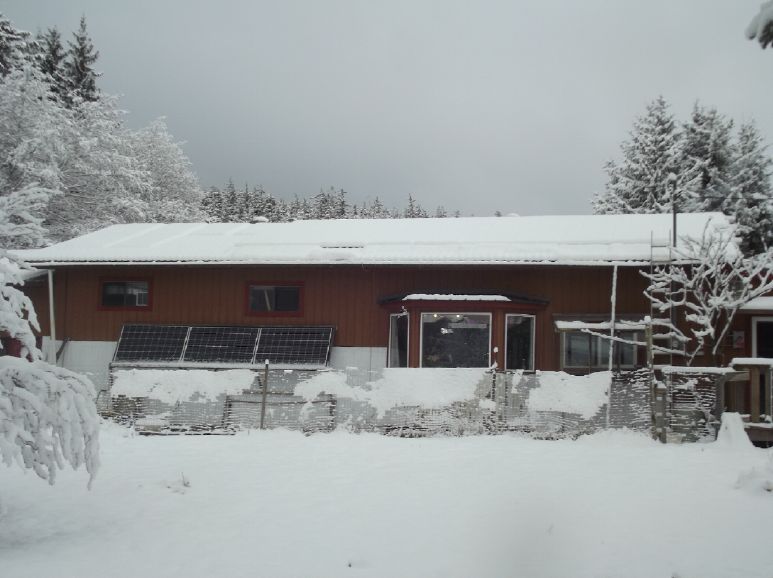
It snowed on March 9th, staying &
snowing over a week and amounting to 8 or 9 inches.
Most of the solar panels kept getting covered. Very bad for
gardening.
Finally it melted but it kept freezing and snowing overnight
until almost the end of the month.
We were promised global warming. I moved farther north.
Should we start a class action suit against the IPCC for false
advertising?
Month
In "Brief" (Project Summaries etc.)
* New Battery Chemies - Building New Indoor-Outdoor Heat Exchanger
for OLAHP - "Short Space Ray" Energy - My Solar - Firewood
In Passing
(Miscellaneous topics, editorial comments & opinionated rants)
* Idea Sketches for Sustainable Societies - Iran et al - Scattered
Thots - Electrosmog Department - ESD
- Detailed
Project Reports -
Electric Transport - Electric Hubcap Motor
Systems - no report (will I ever find time to
finish the next motor?)
Other "Green" &
Electric Equipment Projects
* Open Loop Air Heat Pumping - New Indoor-Outdoor Air Heat
Exchanger
* Faraday Cabin Construction (Ceiling Beam)
* A Little Gardening
New Battery R & D
* More Battery Cells - MOF's: Cu, Mn... Ni?
Electricity
Generation
* The usual Latest Daily/Monthly Solar Production log et
cetera - Monthly/Annual Summaries, Estimates, Notes
March in Brief
The gardening report
and cabin construction are in their own sections below. Faraday Cabin - Haida
Gwaii Gardening
Battery Experiments/Developments/'MOF's
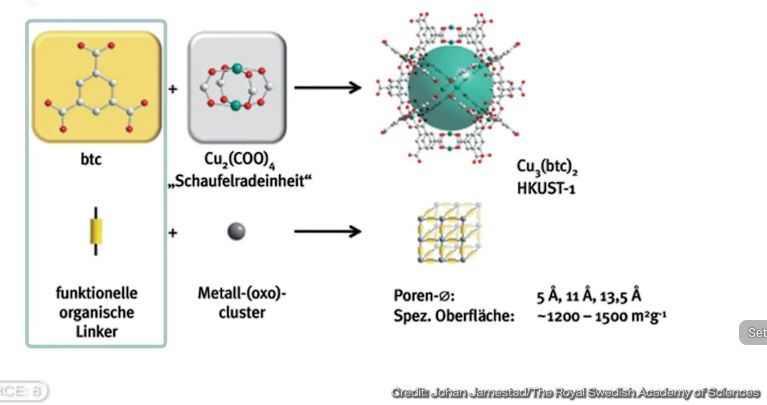 I saw a video from "German Science
Guy" about "metal organic frameworks", "MOF"s - "spongy" crystals
of chelated metallic centers with organic connecting ligands. All
at nano scales. I investigated further. These are a pretty new
idea, that got a Nobel prize. MOF's come in many forms for many
potential purposes (CO2 capture, water filtration...). The idea of
using them with electricly conductive ligands for battery
electrodes was a specific area of interest. Electrolyte could flow
through the "spongelike" nanoporous material.
I saw a video from "German Science
Guy" about "metal organic frameworks", "MOF"s - "spongy" crystals
of chelated metallic centers with organic connecting ligands. All
at nano scales. I investigated further. These are a pretty new
idea, that got a Nobel prize. MOF's come in many forms for many
potential purposes (CO2 capture, water filtration...). The idea of
using them with electricly conductive ligands for battery
electrodes was a specific area of interest. Electrolyte could flow
through the "spongelike" nanoporous material.
Without putting a name to it, that's the sort of
structure I've been groping at with the thiamine/monel substance
for so long, but without very encouraging results so far. (BTW
amines were mentioned as a form of ligand.)
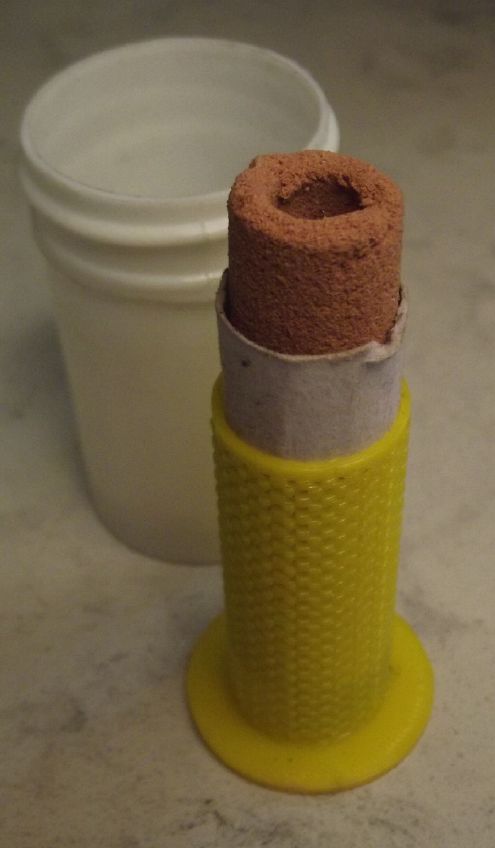 I further improved the
cell design. Now the sand and clay 'pot' with the zinc powder is
surrounded by a perforated plastic outer 'basket', with the
separator paper protected between the pot and the basket. All the
pressing and munching on the outer (+) electrode substance to pack
it in can't abrade or rip the paper. (Perhaps I can make the next
'basket' thinner and more ethereal for better interface area?
...or even just melt some stiff plastic fibers into the outer
surface of the paper to make it tougher and more rigid? Some sort
of open mesh polyethylene maybe? Hmm!)
I further improved the
cell design. Now the sand and clay 'pot' with the zinc powder is
surrounded by a perforated plastic outer 'basket', with the
separator paper protected between the pot and the basket. All the
pressing and munching on the outer (+) electrode substance to pack
it in can't abrade or rip the paper. (Perhaps I can make the next
'basket' thinner and more ethereal for better interface area?
...or even just melt some stiff plastic fibers into the outer
surface of the paper to make it tougher and more rigid? Some sort
of open mesh polyethylene maybe? Hmm!)
I experimented this month with the
copper/monel/organic battery mix, but it still didn't seem to be
performing. I decided to try the same organic idea with manganese
oxide instead. Perhaps Mn3+ in a conductive organic
matrix will recharge to Mn4+, unlike Mn2O3
(insulator) to MnO2 as a simple powder? Manganese has
the advantage of having no soluble states in the cell, so an
osmium film isn't needed on the outside face of the separator
paper. By the end of the month (just a few days) it had perked up
a bit from where it started, but not much. It was only putting out
.23 volts into a 50 ohm load, which improved to .3 volts or so.
It's not very encouraging. But I wonder if the conductivity
through the organic structure is improving with time and charging.
If so it has a long way to go and it's only charging at a little
over a milliamp, so it's taking geologic time. [April 3rd: .35V;
April 6th: .42V -- starting to look promising. Had I been too
impatient with the organic copper? Also, wouldn't it go faster
with metal powder instead of metal oxide powder?] When I run a
brief load charging goes up to recover what was used, but then
returns to the low value.
Should this fail to eventually produce results,
manganese as nickel-manganese oxides does work well, so either way
I do have a very satisfactory battery chemistry that can be
produced. But nickel adds weight and cost without adding
amp-hours.
Imagine that - looking for new battery chemistries
for many years, trying several exotic elements, and ending up with
manganese-zinc, the same combo that's in every common dry cell! --
but with altered construction and Mn substance formulation so that
it's indefinitely rechargeable instead of single use. The
'organic'/'MOF'/'sponge' configuration should have "ultimate" Mn
utilization, or the 'nickel manganates' should still be excellent.
I've noted before that a 145 gram, 1.4-1.5 volt "D"
cell holding 20 amp-hours of charge is around 200 watt-hours per
kilogram - well into practical range for electric transport as
well as low cost bulk stationary storage.
Presently zinc/zinc oxide powder, and manganese
battery oxides complete with graphite conductivity additive, can
both be had for free by extracting them from used dry cells.
That's where I got my MnO2+graphite powder for this 'MOF'. For
production it might be more economical to make a recycling setup
to extract the materials than to buy them new.
[April 4th] Egads! A new idea... maybe MOF with nickel hydroxide
would be a good electrode? Nickel too might be better utilized in
a MOF than in the regular inorganic mixes. And while I don't see
it on the Pourbaix diagram, it might charge from valence Ni2+
through the usual Ni3+ to Ni4+ (or mixed 3
& 4 as "3-1/2+", which valence is shown in the
Ovonics patent), much increasing the milliamp-hours per gram. And
it would have the higher cell voltage of 1.7-1.8 volts, which is
of course also an increase. Could we hit 250 watt-hours per
kilogram? Another promising experiment!
Indoor/Outdoor Heat Exchanger for OLAHP
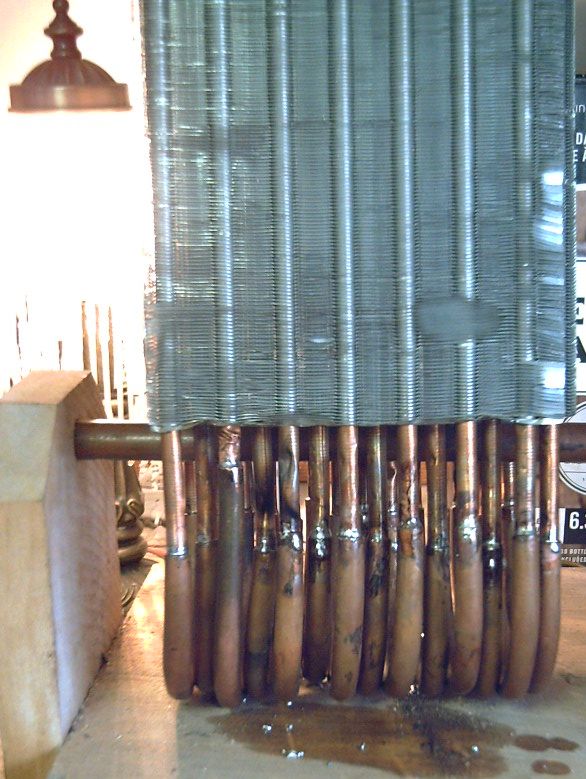 The project continues
at a snail's pace. This month I soldered on the pipes to join the
two sections of heat exchangers, using my smallest propane torch.
The project continues
at a snail's pace. This month I soldered on the pipes to join the
two sections of heat exchangers, using my smallest propane torch.
In order to do that, first I made a little punch to
expand the radiator pipe ends a bit so they fit inside the curved
pieces better, and of course there was a lot of pipe cleaning
prep.
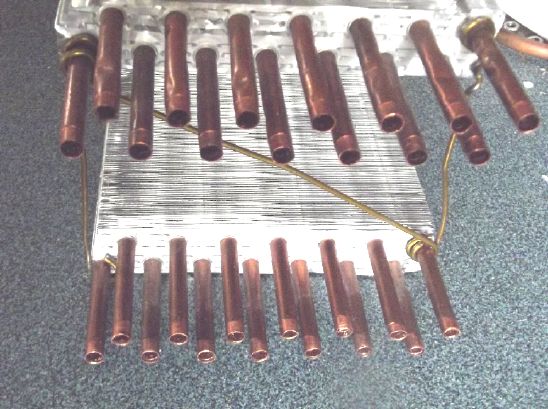
I used pieces of coat hanger wire to
stabilize the other end
I also made a rectangular pipe "manifold" with holes
to solder the seven tubes of one layer of one of them. Things
didn't quite line up because of slightly bent tubes. I decided I
would have to make a special pipe bender to straighten them out
and get them all perfectly aligned.
But even having flattened the manifold pipe
(inserting two 1/2 by 1/2 inch steel bars and pounding the one
inch round copper pipe), it looked like the two layers' pipes
would hit each other. To fix that, I would also have to bend the
pipes upward and downward to make more clearance. And if I had to
do that, why not bend them a little more and just have round
manifold pipes so I could put ordinary fittings on the ends?
So the next thing is to make some kind of little
bender to curve all those pipe ends. Smoothly. Exactly. (I knew
the 14 curved joiner pipes were the easy end!)
"Short Space Ray" Energy
In the coming decades we will have the almost free
energy that Nicola Tesla is reputed to have harnessed to light a
whole bank of light bulbs from no apparent power source around
1900, and which T H Morray certainly did harness in the 1930's
before his lab was smashed and a few others have managed to
capture ever and anon since. The last one I heard of was the two
Brazilian electricians in 2013, who were getting multiple
kilowatts from "Earth electrons". They got Brazilian patents, put
up a couple of youtube videos of their devices in operation, said
they were going to sell the free energy devices locally, and
disappeared - evidently charged with "fraud" without ever having
had a chance to manufacture or sell a single unit. It can't be
suppressed forever. The techniques and technology for harvesting
it don't seem so difficult.
The actual source of this energy is the high energy
rays ("HE Rays", "HE 'Gamma' Rays", "Short Space Rays") 2^10
higher frequency (~10^24 Hz) and energy per photon than
gamma rays. They come from the whole sky but especially from the
plane of the galaxy. They shine through our atmosphere. Their
existence was deduced by Morray as the source of energy for his
devices, but he had no way to perceive and measure them. They were
finally "seen" by "X-Ray Observatory" satellite (Chandra?) and
identified in 2007 IIRC. So far "mainstream science" hasn't
connected this powerful radiation band with the "free energy"
technology that keeps reappearing here and there.
Luckily these rays don't seem to affect life, or even
much interact with anything on Earth unless coerced to release
their energy by electronic means.
I have written of this energy in previous issues
years ago, eg TE News #69 at
first with little understanding, but my thoughts have wandered
across it again and I thought it was a good time for a reminder.
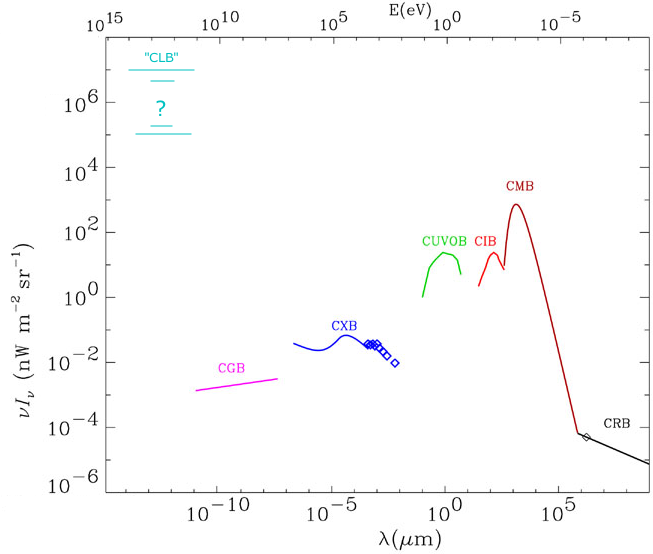 My vague charts from 2013 still seem to
be the only ones showing that the spectrum
My vague charts from 2013 still seem to
be the only ones showing that the spectrum
doesn't end at the gamma ray band, despite the info now being 2
decades old,
Nor is it stated - perhaps is not realized - that the energetic
'new' "HE"
band (which I here labelled "CLB") shines right through Earth's
atmosphere.
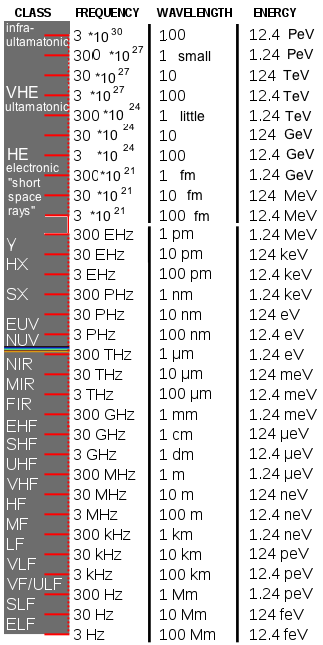
This is my "complete" chart where I added everything
I've heard of beyond gamma ("Y") rays onto the top.
(The Urantia Book says Ultamatons, AKA Higgs Bosson particles,
are the most
basic subatomic building blocks for everything else, and
ultimatonic ("VHE")
rays and beyond round out the 100 octaves of the EM energy
spectrum.)
Ultimatons are probably the chief constituent of the mysterious
"dark matter", since only their gravitational force is
discernible.
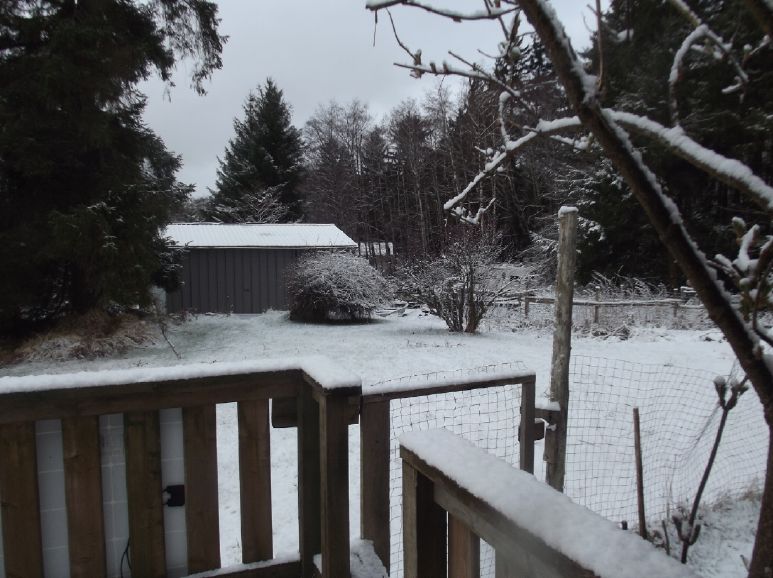
Yet more snow - 22nd.
My Solar
My latest BC Hydro bill said my new 7 KW system had
contributed 70 KWH to the grid. But I used almost 1200 KWH.
However as winter ends things are improving. My tally for March
shows 535.46 KWH generated in spite of the snow. On a rare sunny
day all the panels together hit a new record: over 30 KWH in a
day. Then on the sunny first of April, the grid tied system alone
made 28 KWH. (Plus the two off-grid systems, 38 KWH total.) I look
forward to still better as the days lengthen. And as the weather
warms my grid consumption should drop drasticly. [April 3rd: Wow,
10°c, after snow until a week ago!] A certain percentage of my
electric heat comes from 36V DC heaters on the off-grid systems,
and as days lengthen and weather warms, that amount will rise and
as a percentage it will rise dramaticly.
Firewood
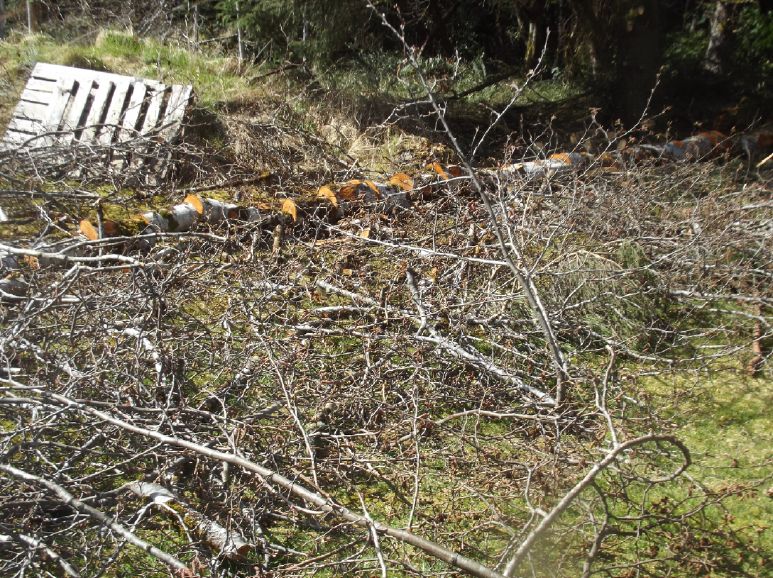 My usual spring routine, when it gets
worm enough to want to be outside but before the sap starts
flowing (much) in the alder trees is to cut down a tree or two
both for firewood and to open things up a bit - or to keep them
from growing in too much. This time my friend and retired logger
Dan Bellis came by and did the deed on this alder after I cut a
small spruce but it got hung up in the branches of the large
spruce and the alder. There's one other one I want to do this
spring... a pretty big alder leaning over my greenhouse and shop.
("Just tie a rope and pull it with a truck so it falls the right
way." or something like that.) Firewood is of course the oldest
form of indirect solar energy. Worldwide it is probably still
providing more energy than nuclear power.
My usual spring routine, when it gets
worm enough to want to be outside but before the sap starts
flowing (much) in the alder trees is to cut down a tree or two
both for firewood and to open things up a bit - or to keep them
from growing in too much. This time my friend and retired logger
Dan Bellis came by and did the deed on this alder after I cut a
small spruce but it got hung up in the branches of the large
spruce and the alder. There's one other one I want to do this
spring... a pretty big alder leaning over my greenhouse and shop.
("Just tie a rope and pull it with a truck so it falls the right
way." or something like that.) Firewood is of course the oldest
form of indirect solar energy. Worldwide it is probably still
providing more energy than nuclear power.
In
Passing
(Miscellaneous topics, editorial comments & opinionated rants)
Planetary Management - Idea Sketches for
Sustainable Societies
WOW, I've dived far deeper into this than I had
intended, almost on the last day! I hope it's not too disorganized
or ill-conceived.
A key to forming socially and otherwise sustainable
societies lies in discovering or inventing more harmonious
societal groups or institutions, and more harmonious forms of
interactions between such groups.
Family
The family is the basic societal institution.
Civilization can't be maintained without good families raising
contented children and passing on knowledge and culture from one
generation to the next. Parenting itself is a skill that should be
taught. Presently there isn't much to go on and parents are left
to fend for themselves, although the knowledge of effective
parenting techniques is scattered here, there and everywhere. One
example is a book titled How to Talk so Kids Will Listen; How
to Listen so Kids Will Talk. I've seen it mentioned in
comments as "the one thing that really helped me" raising a
family, but it seems few have heard of it.
I should think there should at least be some
"Parenting.org" website where every prospective parent or parent
with a problem can look to find tried and proven solutions and
parenting techniques.
Education
The prime goal of youth education should be that
everyone becomes a productive, self-supporting citizen. Education
today seems unfocused. Any goals it may have are implied and not
stated. Why aren't kids taught basic economics and money
management?
I got a book when I had the "Book Barn" mini library
in front of my house in Victoria BC, Hacia una Economia Ideal
(Toward an Ideal Economy). The author himself, Roberto J.
Marquez put it there to see what would happen. I had previously no
interest in trying to read Spanish, but the title got my
attention. He had retired from Mexico to Victoria. I had coffee
with him once. That was about 2014. I kept the book. The intro
translates:
What is in these pages?
Basic principles of economy known
to all since forever, but
applied today by very few.
We must take off the blindfold that
we have had over our eyes,
to see how we are being
manipulated by the big interests
through the press, radio
and television, which they
totally control at will.
All depends on us.
He talks about how people get sucked into credit card
debt, shopaholics, impulse shopping & buying things we don't
need, and contrary, being frugal, thinking about "Do I really
need?" something a while before running out and buying, waiting
until we can pay for it, etc... Why aren't there books like this
in our schools?
One may perhaps answer "Because the corporations
don't want us to think about such things." And that reveals
another big problem with our societies: What is wrong with our
societal structures that some should want to control others'
access to information? And lately, to control what information -
or opinions or viewpoints - we ourselves may choose to share with
others? What are the root causes of these feral elements in our
societies who don't want free information interchange?
What is the origin of such disharmonies in our social
structures, institutions and the way in which they interact with
each other and with individuals? How do we change our institutions
to be more harmonious?
Economy
Economic institutions are perhaps the lion's share of
organized activities in our societies, at least in terms of the
number of participants and time devoted to them. We have seen in
the Soviet Union and other states that leaving personal benefits
for personal efforts out of the economic structure results
disastrously. It's also seen in "the tragedy of the commons" where
no one wants to look after the commons field just for someone else
to graze his sheep there, and the one grazing his sheep has no
incentive to go elsewhere until the grass is gone. So "the
commons" becomes a wasteland. I've heard that the first American
settlers tried to have everything in common and almost starved
before they decided there did, after all, have to be private
property.
Perhaps "socialism" can work in some form, but not
when it means the indolent live off the efforts of the productive
without compensatory contributions of their own.
We also see that "private enterprise" or "capitalism"
tends to put bigger and bigger blocks together, and once a block
is large enough, it gets government to pass laws that lock others
out of "their" field. Someone "wins" the competition. The ultimate
end result could be one mega-corporation that owns and runs
everything, or a small clique of huge corporations that cooperate
together, which we seem to be seeing.
Without having any very creative suggestions of
my own, I think we need to design new structures, or rules that
provide more equitable distributions of rewards for efforts among
the participants. I'm sure others have some good ideas for new or
improved ways to run economies.
Hmm... Come to think of it, Canada's "Crown Corporations" plan
seems to work well for some large scale institutions - at least
when politicians don't give away these public assets to private
interests. They are "arms length" from the government that
commissioned them (federal or provincial) and run similarly to
other corporations except that they operate either as "break even"
or profits are remitted to the originating government to reduce
taxes. In Canada "The Crown" means the government. It no longer
has any connection to royalty. If one doesn't like the "archaic"
name, one might instead call them "public corporations" or "public
trusts". A government official(s) probably has a seat on the board
as a public watchdog. Here are some examples.
- Since 1972, ICBC (Insurance Corporation of BC) is the monopoly
for motorist liability insurance. It pays all its excess (about
90% of revenue from drivers' insurance premiums) out in accident
claims. When accident rates are high ICBC has even directly paid
police to patrol and enforce specific safety regulations in
specific places, reducing accidents and claims. Some scams (eg,
braking right in front of a big truck and being rear-ended) have
been caught and claim payments reversed. Recently with lower
accident rates, they have gone so far as to issue premium rebate
cheques to individual motorists. IIRC private companies pay out
about 60% of revenues in claims. Are we not getting considerably
better service from the crown corporation?
- AGT (Alberta Government Telephones) used to run Alberta's
telecom services in the days before internet. Then it was
sold?/given? to private company Telus who also acquired BC Tel and
merged the two. Telus have upped service rates to the max they can
get away with, and even on top of that have run scams and excess
billing schemes. They also scheme to effectively block or buy up
their competition. I'm sure we were better off with a crown
corporation doing our telecom services.
- Canada Post Corporation was made into a separate entity and is
for the most part no longer tossed around as a political football.
I understand that it is presently almost bankrupt. I haven't
followed it but the government is probably interfering, not
allowing them to raise postal rates to break-even prices, as was
also the case of the US post office under president Obama in order
to hold inflation statistics artificially low. (Of course, the
scene is changing too. There are now few magazine subscriptions
and less ad-mail, bills are rarely paid by mail, and letters are
sent as emails. So the post office is becoming to a considerable
extent a parcel service as letter-mail service reduces.)
- BC Hydro & Power Authority was created even by a
"capitalist" oriented government seeing how "rogue" the private
company "BC Electric" was. (1950's?) It seemed to be running well
to me, but another government gave away many of its assets and
operations to private interests a couple of decades ago. This
hybrid arrangement seems to be working okay AFAICT. KWH rates
doubled around the same time period but there were definitely
political factors involved in the previous low rate and in the
increase.
Governance
When the idea first arose of electing a people's
representative legislature, it was supposed that those elected
would be a representative cross section of the society that
elected it. Instead those elected mostly all had similar sorts of
talent, interest and knowledge bases, and they divided themselves
into two adversarial "parties" that each voted as a block. Clearly
this was not what was intended, but legislative power now resided
with the legislature and anyone who got any better idea for fixing
it had no power to do so. Those now the elected had the power but
no inspirations, incentive or inclination to fix it. It soon
became part of the culture, "That's how it is." No provision had
been made for correction of such a mistake, and legislatures have
now run this way for centuries with few or no changes.
Our present governing institutions are outdated and
have become inadequate, but they are ossified and unable to evolve
from within or to be changed from without. Societal decision
making power must no longer be transferred to a small political
class who generally have no particular expertise or qualifications
to make decrees on many or most of the matters they are deciding.
Advancing societies today are too complex for that and decisions
are often being made behind the scenes by the wealthy with vested
interests and "rubber stamped" by our elected officials, who are
often beholden to those with money to fund their election
campaigns. Our present trajectory is toward authoritarian rule by
unresponsive and unaccountable elected governments representing
only the donors of the elected -- representative democracy in name
only. Candidate selection processes and elections may be rigged to
ensure outcomes. At some point even the pretense of democracy may
be stripped away.
I have recently written a couple of suggestions for
improvements:
1. Unrepresented Constituencies - Why a representative legislature
isn't a cross section of the society that elected it and doesn't
seem to represent us. And how it could be.
https://craigcarmichael.substack.com/p/planetary-management-unrepresented
2. Volunteer Citizen Appeal Tribunals - We don't need to be
elected to get together and study an issue and render a moral
verdict and give it publicity, to tell everyone that someone or
some department in government or civil service seems to be doing
something wrong - overreaching, misapplying a law, punitive to
someone or against the public interest or the interests of
citizens as individuals. Public pressure plus a carefully
considered written verdict may well get a thing changed, and once
done, then it may be done again and become an institution.
https://craigcarmichael.substack.com/p/planetary-management-volunteer-citizen
Of course there are many directions of advancing
political thought.
Today the talent of knowledgeable and concerned
citizens everywhere should be combined in research and planning
groups, "Social Sustainability Design Teams", to formulate and
propose governing regulations on multitudes of complex issues.
When many such groups connect through the internet
their combined recommendations represent the will and expertise of
the relevant, concerned and educated public. Such submissions must
then carry much weight with elected governments responsible for
enshrining them into law.
Professional associations such as IEEE or ASHRAE may
perhaps be taken as inspirations. Members meet together and set
regulations on electrical and HVAC matters. The politicians adopt
them into law because they have been thoughtfully decided on by
knowledgeable and organized groups. We need citizens doing this on
a multitude of subjects where unhelpful rules and regulations have
been put in force out of line with people's real needs.
Daniel Raphael, PhD, writes extensively such on
topics of how to build a socially sustainable civilization which
will never collapse, notably in his recent work:
The Second Civilization
Part 1 - The Logic Sequence for Changing the Trajectory of Western
Civilization
Part 2 - Organic Philosophy — Intellectual Philosophy
109.04.01-2nd
CIVILIZATION.pdf
A key consideration discussed in this work is the
core values of being human, expressed as: Life, Equality, Quality
of life, [opportunities for] Growth, Empathy, Compassion and Love
[for humanity, life and living], and their core application to and
by the institutions of a sustainable society.
* Youtube channel "CGP Grey" has a good video on The Problems with
"First Past the Post" Voting Systems (which I would call "Nearest
Toss To the Post" or "the illiterate's 'X'" vote), and another one
on Choice Ranking voting.
* I've seen theoretical cases/arguments where choice ranking might
not produce an optimum outcome, but it's hard to imagine an
actual, practical case. I doubt there'd be 1 case in 1000. Mostly
nothing yields a worse result than the "illiterate's 'X'". But
political parties gaining power by that unfair system are lothe to
change it.
(
A "case" I saw for choice ranking not working well was that: an
airport is to be built. It could be built at equal city "A" or
"B", or smaller town "C" in between. The first choice for
residents of "A" and "B" would be their own city. But everybody's
second choice would be town "C", so the airport would be built
there and only the few residents of "C" would be happy. But the
case itself is contrived and also it misrepresents the counting
process. Is it the best they could come up with?
1) Airports are always inconveniently built outside of cities. No
one gets to walk to an "in-town" airport anyway.
2) If "A" and "B" are very far apart, don't they each need an
airport? If not what's the problem with any particular location?
3) Geography or other factors may dictate the location, or at
least the best one, anyway.
4) Since when did people get a vote on where an airport goes?
That's what I mean about "theoretical" cases versus actual and
practical.
5) But on top of all else, that's not even how it works! When the
votes are counted, the least popular option, "C", is eliminated.
That would leave only the two large cities in the running. In the
second round of counting, only the second choices of eliminated
small town "C" are tallied. These votes would put "A" or "B" over
50%.
)
Iran et al
It seems some long time bad actors in the world are
finally being eliminated... the powerful Latin American drug
cartels, the destructive Islamic regime in Iran with its
satellites Hezbollah, Hamas and the Houthis and terrorism cells
coming to light here, there and everywhere (Wow!), and
Dictatorship Cuba. Once the turmoil is over the people in the
affected nations are almost bound to have better lives. And
perhaps overthrow of corruption and evil designs will become a
global trend?
Well, I started a writeup on my perspectives about
Iran on one computer, then I wrote some more on another. I don't
see any simple way to merge the two into a single essay, so I
think I'll just present them both.
Writeup #1
In the considerations of Iran, one central thing
finally came into focus: Ali Khamenei had to be stopped. Now.
Before he would have soon been ready to start World War Three on
his own preferred terms. I think Saudi prince Mohammed bin Salman
("MBS") was right: he was the most dangerous man in the world.
Khamenei's regime had students from the earliest school grades
chanting "Death to America; Death to Israel!" - a reverent morning
prayer for peace and brotherhood to our Father in Heaven. People
buying into such evil propaganda from childhood are prepared to do
violent things that most of us find hard to believe anyone beyond
the odd luny would do.
Here's a video interviewing someone associated with
Israeli intelligence dating from before the start of the attacks,
but after the regime murdered those tens of thousands of it own
citizens in January [2026]:
Iran’s Secret Plan to Destroy Israel — And Why Hamas Ruined It |
Dr. Mordechai Kedar
Youtube channel: Stand Tall Israel
https://www.youtube.com/watch?v=-tqZ7bL8Yps
Killing 30000 or 40000 unarmed protesters and
declaring that they would hang the Iranian women's football team
for not singing the anthem in Australia, among a zillion other
murders and atrocities over the decades, well, most of those were
against their own people. How much less would Khamenei care be
what happened to foreigners when he had nuclear weapons and the
rockets to deliver them anywhere? They claimed their missiles
could reach 2000 kilometers -- then they struck at Diego Garcia,
3600 kilometers away. So their missiles could actually reach 4000
kilometers! That means they could already hit most of Europe!
ICBM's to hit the Americas are only a step up from that. Eleven
atomic bombs were perhaps weeks away in spite of the Israeli and
American strikes on uranium enrichment facilities last June. There
would have been no hesitation, no compassion. Israel would almost
certainly have been destroyed and the land rendered uninhabitable
for hundreds of years. The radiation would have spread around the
world. Atomic retaliation at that point would spread further
nuclear radiation, probably utterly poisoning Iran too.
Does anyone remember in the late 1950s and early
1960s when kids' lost teeth (including mine from Edmonton,
Alberta, Canada) were being sent for radioactivity tests after the
nuclear bomb tests of the 1940s and 1950s? And Bikini atoll was
rendered uninhabitable (still is) by the first hydrogen bomb
tests? A low level of extra radiation was global, making (IIRC)
the Van Allen radiation belts around the Earth flare up. All
further nuclear testing was moved underground by treaty. Does
anyone remember when irradiated food from Scandinavia was
considered unfit after the Chernobyl nuclear reactor meltdown in
Ukraine? And that a wide Chernobyl area is still abandoned owing
to high radiation levels? The potential of radiation from bombs is
to to kill billions, to make vast parts of the Earth uninhabitable
for at least decades, perhaps hundreds of years or longer, to make
generations of humans suffer and die young with rampant cancers,
and indeed possibly to make the whole world too uninhabitable and
end the human race.
The choice was: Stop Khamenei now or do nothing and
risk these ultimate and only too possible outcomes. Mostly
"nothing" has been done since the rise of the extremists in Iran
in 1979. Thank God there's presently some strong leadership with
military strength on the side of freedom and progress, too!
Netenyahu and others have said Ali Khamenei was "not replaceable"
-- no successor could replicate his authority, drive and
[diabolical] program. (Would World War 2 have taken the same
course without Hitler? What if Germany had been struck before
becoming so strong?) Everyone hopes he's right, but the war to put
an end to the whole extremist regime continues.
Here's another video, from March 24th [2026] - people are hopeful
the regime will be ended soon:
EXPERT: Irans Regime Is Collapsing Before Our Eyes - They’re Also
Getting Desperate!
Youtube Channel: JNS TV
https://www.youtube.com/watch?v=C0LHZZQdMJ8
But events are still in rapid progression. No one
really knows how it will play out. The greater the confusion, the
more wildly different vectors of probabilities are open. But Ali
Khamenei has been stopped. Virtually any outcome now is already
far better than if he hadn't been.
Writeup #2
In Iran by many opinions one may get the idea the
regime may stand through thick and thin and emerge at the end of
the day still in control of the country; that the world will be
stuck with a radicalized Iran forever, regardless. But the US
strikes have knocked out their military production and air
defenses, and the Israelis are most effectively striking at the
regime's leaders and even military and police "crowd control"
personnel with FPV drones ("First Person View" via camera on the
drone) as well as air strikes. It must be devastating for any
government to be unable to show its face in public in the land
they purport to rule, or for its officials to meet together
without being attacked and killed. And with the "head devil" and
dozens of his chief supporters gone, great change is already
inevitable.
After seeing the Russia/NATO war in Ukraine drag on
for years, the speed, effectiveness and selectivity of the strikes
on the Iran regime and its military and military production have
astonished me.
The new Israeli technique of locating and directly
executing those in command seems like virtually a new way of
fighting a war, bypassing the enemy's army and not laying waste to
a nation's civil infrastructure. Albeit it's not terribly
discriminating about the few in the rulers' proximity at the time
and nobody gets a formal fair trial. Perhaps Napoleon's maxim
"Frappez la masse et tout le reste vient par la surcoit." may now
be changed to "Frappez la tête du serpent et le peuple sera
peut-être libéré." (Strike the head of the snake and the people
may be freed. Never mind striking the mass of the army!)
Of course, with the regime having had decades to
build air defenses and weapons of mass destruction, the American
contribution of striking military targets was also required and
may still be in decreasing degree. Such amazing precision strikes
on leaders and specific military assets have never been possible
before. The fanatical regime seems virtually crumbled. I hope the
strikes don't go too far now and start laying waste to Iran for
nothing.
Last time Iranians gathered in public (for a
traditional festival), Israeli drones were there to shoot at IRGC
personnel should they appear and open fire on the crowd. This
should be highly efficacious if continued unless the regime finds
effective countermeasures to the drones.
Iranians everywhere are calling on Reza Pahlavi as
interim leader to avoid the chaos of leadership vacuum. Pahlavi
and his team are directing small serial uprisings from abroad to
exhaust the regime's defenses without risking the scale of
slaughter seen in January (the 30000-40000 unarmed civilians
killed in uprisings all across the country). In fact, when the
allies started bombing, they told Iranians to stay home until a
propitious moment to rise up should arrive. Until then, and with
the Iranian military and governing infrastructure being blown up
left and right, "It's too dangerous."
Everybody seems gung-ho for completely overthrowing
the extremist regime in Iran except Trump. Why does he seem to be
negotiating with them? But then he claims the old regime is
already gone - after all, dozens of its top leaders have been
eliminated along with the "head devil" Ali Khamenei. But will
Pahlavi ever be able to return to Iran without being killed?
I don't think the Iranian people, or Israel, are
going to settle for anything but complete elimination and
functioning democracy in Iran. I hope they are able to take charge
of their own affairs. The best outcome, a peaceful, democratic
Iran, would change the whole face of the Middle East, and it might
become a leading nation of the world. But we might end up instead
with an Islamic regime that has given up its imperialist
ambitions. At least if there is peace and no more slaughter of
civilians there is chance for eventual or gradual peaceful change.
* The word "Aryan" comes from "Iran". There is probably a good
gene pool remaining in that population. While all people are
inherently lovable and bigotry and prejudice are evil, the world
should value and foster its higher genetic strains among all races
because they are in short supply. From the middle east and Iran
sprang the various Indo-European peoples. Certainly it is an
ancient and established civilization with peoples capable of
wresting a good living from a hostile environment while making
beautiful art and architecture.
Scattered Thots
* I'm for staying on Standard Time (PST) and turfing Pacific
Delusional Savings Time (PDT) into history's wastebasket of stupid
ideas. Stores here open at 10:30 or 11 AM and break for lunch from
1 (AM) to 2 (PM). And even those times are early because here in
summer on Delusional Time, the clock is almost two hours ahead of
the sun and noon is almost at 2. 12 o'clock is too early in the
morning to have lunch.
I've sometimes gone into town "a bit late" without
thinking about the time, only to discover the stores are already
closed because it's "after 5 PM" - ha ha. Or the credit union is
closed ("3 PM") with the sun only an hour past its zenith.
Others in Northern BC have also asked that "PDST" (an
anagram of "PTSD") be eliminated.
* Oh No! Now I hear our illustrious BC premier says that instead
of getting rid of it, we are going to stay on delusional savings
time forever! First 3 months DST (1960's), then 6 (1980's), then 8
(2010's?)... now 12? That's just redefining what the clock and
"time of day" means. I pity the working people on bureaucratic
schedules who have to get up at "6 AM" which is now actually 4 AM
-- even in winter? It goes against man's natural diurnal rhythm.
* Another amelioration we might achieve is to split BC into two
time zones. Port Hardy on Northern Vancouver Island is actually at
the dividing meridian and most of coastal Northern BC is west of
that. Fat chance of having the provincial government agree to that
unless we gain a lot more local autonomy in local decision making.
* There are many good Youtube channels covering current affairs. A
good Youtube channel following both Ukraine and Iran daily is
"Millitary Summary". A couple with news "from the ground" that are
very hopeful about Iran overthrowing its regime are "Tousi TV"
(Iranian exile in London) and "Tal Oran, the Traveling Clat"
(Israel). (I'm probably being unfair in not mentioning a few other
fine channels.)
* And of course there's the ongoing news feed at Zerohedge.com for
essays and reports by many people on many subjects.
* In consideration of the Morse code I hear in my head whenever
it's quiet, I looked up Morse code. I've already known most of the
letters since my Coast Guard electronic technician days. I now
filled in the forgotten few. I could see the letters weren't well
optimized in terms of the more common letters being the shorter
codes to send. Samuel Morse didn't have a computer - for a good
survey he would have had to count occurrences of letters through
at least a few documents by hand. Then I looked at the numbers.
They're a good example of something that was hardly thought out
that became "the standard". Probably numbers were an afterthought,
because these codes are much harder to excuse! To whit:
0 _ _ _ _ _
1 . _ _ _ _
2 . . _ _ _
3 . . . _ _
4 . . . . _
5 . . . . .
6 _ . . . .
7 _ _ . . .
8 _ _ _ . .
9 _ _ _ _ .
To be sure, the alphabet exhausted most of the four taps or fewer
combinations, so the numbers have to be five 'bits'. Still, zero
is by far the most common digit, followed by one. Consider 1000. A
common number. It couldn't be longer to send!:
. _ _ _ _ _ _ _ _ _ _ _ _ _ _ _ _ _ _ _
5555 would be a much less common number, but the shortest to
transmit - all "dits". . . . . . x 5
A much more logical system would be all digits (and perhaps no
other five bit codes?) starting with a dit.
0 . . . . .
1 . . . . _
2 . . . _ .
3 . . . _ _
4 . . _ . .
5 . . _ . _
6 . . _ _ .
7 . . _ _ _
8 . _ . . .
9 . _ . . _
No digits with more than three "dahs". So, 1000:
. . . . _ . . . . . . . . . . . . .
. .
Even better, zero and one (only) could be shorter
than five.
Of course, Morse code is just about a thing of the
past now. May it go the way of the dodo and the great auk.
Presumably this is just an academic exercise.
Electrosmog Department
(I can't seem to get away from this topic, so here's its own
place!)
Friend Ross Plourd & his wife have moved from an
abode almost under the 14,400 volt power lines to an off grid
acreage over half a kilometer from them. He says they weren't
sleeping well, but from the first night at the new place it was
"Whew, Relief!" and they slept fantastic all night.
 Realizing that while tinnitus in the
ears is my (known) problem, the EMF from AC electric and magnetic
fields probably is induced into the whole body, it occurred to me
to look on line for a conductive sweater. Instead I found a fairly
long conductive jacket that covered down to the legs. It had
buttons instead of a zipper. I ordered it anyway. I hope I like
wearing it. Nothing else looked warm, which is a jacket
prerequisite here much of the year.
Realizing that while tinnitus in the
ears is my (known) problem, the EMF from AC electric and magnetic
fields probably is induced into the whole body, it occurred to me
to look on line for a conductive sweater. Instead I found a fairly
long conductive jacket that covered down to the legs. It had
buttons instead of a zipper. I ordered it anyway. I hope I like
wearing it. Nothing else looked warm, which is a jacket
prerequisite here much of the year.
There were shielding "hoodies" too. Maybe I'll try
one of those some time.
With my other tinnitus somewhat reduced the Morse
code in my head previously mentioned, even two or three stations
at a time, became more annoying. Where on Earth would Morse code
still be used, broadcasting 24/7, in this day and age? Only
because I worked in the Coast Guard 1976-79 as an electronic
technician, I know that it's CW/Morse code marine weather
broadcasts in the LF band below the AM (MF) radio band at around
500 KHz. When I was in a radio office and saw someone keying out
the broadcast, it was all "deva vu" for me since it was the same
sounds I had been hearing in my head for some years. And I think
that if I hear it, there must be millions of others too, who have
no idea what it is, where it's coming from, or who to ask or
complain to about it. It's just "low-pitch tinnitus".
So I wrote the Minister of Transport in Ottawa and
suggested that there are probably no ships listening to Morse code
in the LF band any more. It used to be the only thing that could
penetrate out to the middle of the oceans. It's the band on which
the Titanic sent its famous distress call in 1912. Now there's
satellite phones and internet, now Starlink. Anybody can talk to
anybody from anywhere in the world including on the high seas. Who
would bother cluttering up a ship's deck with a very long wire
antenna and have an extra piece of radio gear just to get
primitive Morse code signals, when one can bring up the whole
world's weather in complete detail on a screen any time, anywhere?
And there must be multiple ways to make a distress call - or any
call - via satellite, too.
So I'm pretty sure that it's only being broadcast
today because no one has thought to shut it down, and it's been
transmitted by computer since the early 1980's so no radio
operator has to sit there keying it out. (That's also when it
inevitably became 24/7 instead of scheduled transmissions.) I
pointed out that probably he was the one person with the authority
to have the CW weather broadcasting ended. (And he probably
doesn't know a thing about it!)
[31st] I woke up at 6 AM and thought "My ears are really ringing.
Why?" It completely drowned out the Morse code. Nothing was on
except that I had plugged in my power diode bridges heater. It was
DC - nothing switching or AC. Then I realized that to plug it in,
I had unplugged the ground to the conductive fitted sheet under
the mattress liner on my bed. Wow! So it was letting through the
AC fields from the 120 V heaters across the room. And here I
hadn't thought it really made much difference!
And I keep having nights where my tinnitus stays
louder. I forget to turn off the DC [switching] power supply, or
this computer near my bed (virtually no indication it's on after
the screen goes blank), or I've brought out a cordless phone and
forgotten it nearby. And then I kick myself, but actually I seem
to have a lot of daily things to remember all told.
ESD
(Eccentric Silliness Department)
* 10t - An abode for camping trips.
* 6 S - A favorable outcome
* S S S S S S - Plural of above
* Iran: Past tense of "Irun".
* Iraq: To start a pool or billiards game.
* Many kings had Roman numeral numbers after their names, like
Richard III or Louis XIV. James Bond was agent oh-oh VII. Maxwell
Smart was Agent LXXXVI. China is presently ruled by a despot that
goes only by his number, XI.
* Would it be evil to steal the "e" off the end of "vile" and put
it at the beginning?
* If polar bears emigrated to Antarctica would we call them
bipolar bears?
* Hormuz goes around a sharp bend. How can they call it a
"strait"?
"in
depth reports" for each project are below. I hope they may be
useful to anyone who wants to get into a similar project, to glean
ideas for how something might be done, as well as things that
might have been tried, or just thought of and not tried... and
even of how not to do something - why it didn't work or proved
impractical. Sometimes they set out inventive thoughts almost as
they occur - and are the actual organization and elaboration in
writing of those thoughts. They are thus partly a diary and are
not extensively proof-read for literary perfection, consistency,
completeness and elimination of duplications before publication. I
hope they may add to the body of wisdom for other researchers and
developers to help them find more productive paths and avoid
potential pitfalls and dead ends.
Electric
Transport (No Reports)
Other
"Green" & Electric Equipment Projects
Open Loop Air Heat Pumping (OLAHP)
Indoor-Outdoor Air Heat Exchanger
I thought I'd wait for some warmer weather to do the
soldering outdoors. Then... SNOW way into MARCH?!? Day after day I
kept thinking it had to warm up and the snow melt. I worked on
other things.
I'm surprised how little interest there seems to be in this
idea and technology, and I do wish I had some support for the
project. The pivoting vane rotary compressor should be fantastic,
but my confidence in the one I've been making is low. So I started
working on the improved exchanger instead. It took a month to 3D
print all the baffle boxes to direct the incoming airflow back and
forth through the fins.
[17th] All the 3D printed baffles would be for naught unless I
could solder the radiators together without leaks and connect them
up. I didn't like the looseness of the fit between the pipes on
the radiators and the pipes I had cut and bent to connect them.
But they were the only size close. I came up with a new idea:
expand the ends of the radiator pipes from the inside until they
were a better fit.
I took a bolt and turned it down on the lathe to
about the size I wanted. Then I filed it, then polished it, so it
would push smoothly into the radiator pipes to expand about the
end 1/2 inch. I oiled it but there was a lot of friction and it
didn't go in easily. It put it in a drill and tried turning it in.
That worked but for some reason that expanded the very end
oversize and it had to be filed down for the elbow pipe to fit
over it. Worse, after a couple of these, the drill twisted one of
the radiator pipes around, crumpling it and breaking it off. Oh,
great!
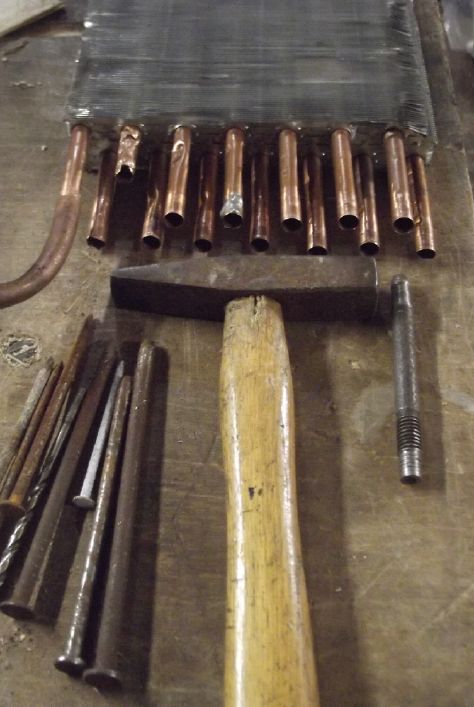 I changed the (?)punch
so that only a "ball" near the end was the full diameter I wanted.
Then it could be pushed in and pulled out at slight angles without
bending the pipe. And it had much less friction. I ended up taking
it out to the workshop, setting up an end stop for the radiator to
pound against, and hitting the tool with a hammer to drive it into
each pipe. Then I could twist it out with a pair of pliers. I
decided to do all the pipes on one end of one radiator. By then I
was cold.
I changed the (?)punch
so that only a "ball" near the end was the full diameter I wanted.
Then it could be pushed in and pulled out at slight angles without
bending the pipe. And it had much less friction. I ended up taking
it out to the workshop, setting up an end stop for the radiator to
pound against, and hitting the tool with a hammer to drive it into
each pipe. Then I could twist it out with a pair of pliers. I
decided to do all the pipes on one end of one radiator. By then I
was cold.
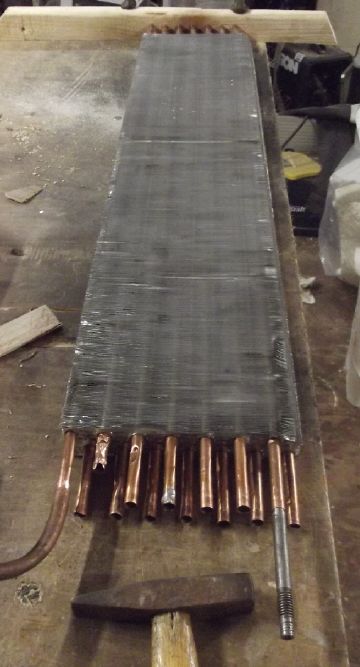 But what about the
broken one? The end was pinched shut in a ">" shape. I bent it
toward straight without breaking it off. I filed the end shorter
until there was a bit of a hole visible. Then I started tapping in
nails starting with a thin one with the point filed to a chisel
shape, then larger ones. When I got in to the next collapsed area
I worked carefully with the nails and finally got it straighter
and opening up. I didn't go for perfection. There was already one
small hole in the side that will need a blob of solder, and I was
very afraid of breaking the whole thing off flush with the fins.
Finally I had it to where I think I can just make a longer "U" end
pipe and solder it on. (with enough attempts?) I think I spent as
long on this as on the whole rest of the operation.
But what about the
broken one? The end was pinched shut in a ">" shape. I bent it
toward straight without breaking it off. I filed the end shorter
until there was a bit of a hole visible. Then I started tapping in
nails starting with a thin one with the point filed to a chisel
shape, then larger ones. When I got in to the next collapsed area
I worked carefully with the nails and finally got it straighter
and opening up. I didn't go for perfection. There was already one
small hole in the side that will need a blob of solder, and I was
very afraid of breaking the whole thing off flush with the fins.
Finally I had it to where I think I can just make a longer "U" end
pipe and solder it on. (with enough attempts?) I think I spent as
long on this as on the whole rest of the operation.
The snow had [mostly] melted and the weather improved
somewhat, but by this time I was shivering and I remembered why I
had been working on indoor things. In the grocery the previous day
I overheard someone say more snow is forecast. I hope that's
wrong! [It wasn't.] There are many things I want to do when the
weather warms up a bit.
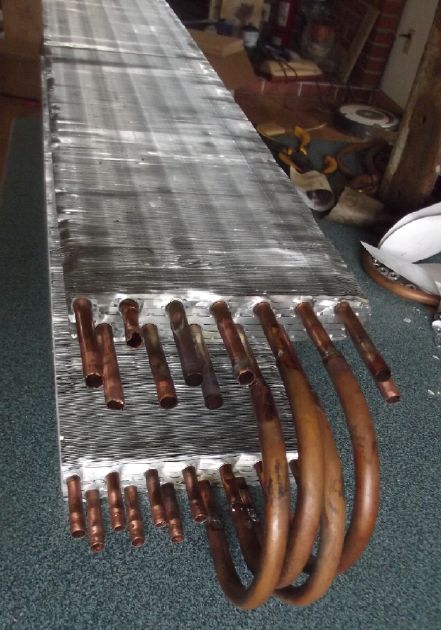 [29th] I decided to do the soldering in the
house. I cleaned off the outside ends of the radiator pipes and
soldered four on with a small propane torch. I flipped it over and
wasn't satisfied that the solder had flowed everywhere, so I
re-did some joins with the unit the other way up. Ten of these to
go!
[29th] I decided to do the soldering in the
house. I cleaned off the outside ends of the radiator pipes and
soldered four on with a small propane torch. I flipped it over and
wasn't satisfied that the solder had flowed everywhere, so I
re-did some joins with the unit the other way up. Ten of these to
go!
 [30th] Is there some way to hold the assembly
vertical so that the solder flows better into the joins? The
soldered pipes hold the one end solidly fixed together. I guess I
need a really good way to hold the other end solidly, then I can
handle the unit more freely. (But still very carefully so as not
to bend the fins all up - they're already a bit the worse for
wear.) Maybe coat hanger wires or similar looped around the pipes,
between the two radiators and diagonally?
[30th] Is there some way to hold the assembly
vertical so that the solder flows better into the joins? The
soldered pipes hold the one end solidly fixed together. I guess I
need a really good way to hold the other end solidly, then I can
handle the unit more freely. (But still very carefully so as not
to bend the fins all up - they're already a bit the worse for
wear.) Maybe coat hanger wires or similar looped around the pipes,
between the two radiators and diagonally?
Sure enough. 3 Pieces of coat hanger wire, bent just
so, seemed very good.
[April 2nd] With everything held together, I
turned the unit vertical with the "U" join pipes at the bottom and
gravity pulling the solder into the joins. I set it on a wire
spooler to help hold it in place. I soldered on the rest of the
pipes.
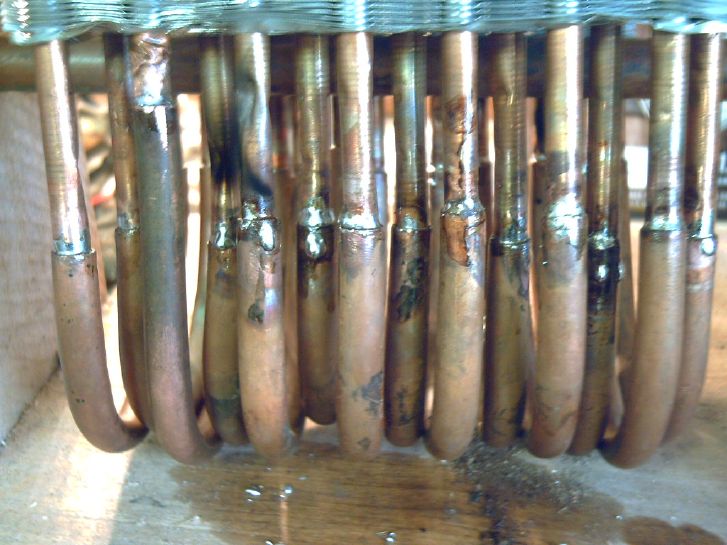 I still redid some joins more than
once trying to ensure there were no leaks. 28 soldered joints. I
guess I'll find out.
I still redid some joins more than
once trying to ensure there were no leaks. 28 soldered joints. I
guess I'll find out.
This was the easy end (actually the midway point of
the folded-over unit). The other end needs four manifolds each
holding seven pipes 21 mm apart along one side, and having one
irregular shape soldered-on end seal and one irregular shape
connection to combine two manifolds into one round pipe... all
with no leaks! Yikes!
"Faraday Cabin" Construction
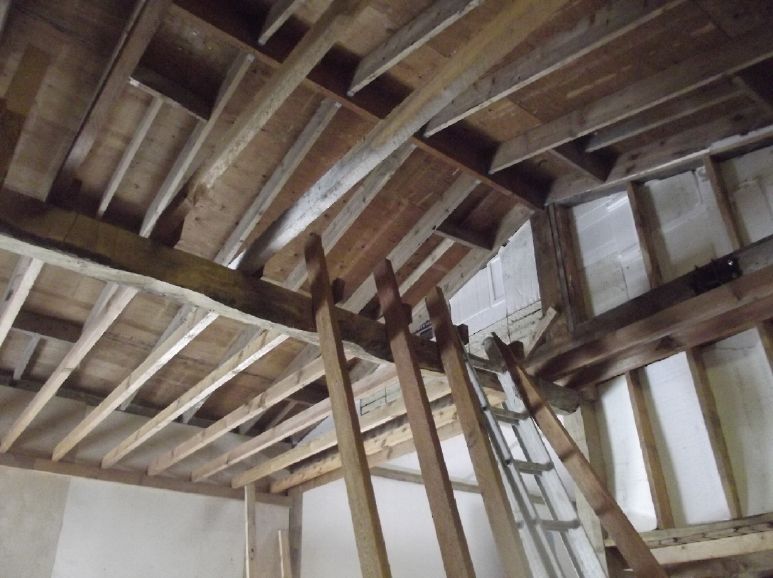
Previously -
south side rafters are up
[9th] I put up the east end rafter
against the wall, screwed on level, and then did some wall
insulation.
I used R12 fiberglass - I have two bags left to use
up, and about that much wall left. Scrap styrene foam insulation
is great but mostly is available in small, thin pieces which are
quite labor intensive to fit in. I already only take flat pieces
with no holes. In future if I ever do more I think I'll pass on
foam less than an inch thick. 2 or 3 inches is better - 4 or 5
inches for between rafters.
I will say that beyond reasonable comfort essentials,
I'm not worried about conforming to the ever-thicker walls and
insulation building standards. First, I'm putting in a woodstove,
which provides lots of heat cheap mostly from trees I want to cut,
if for a certain amount of labor. The cabin will probably get too
hot if I light it in shoulder seasons. But that's not the only
thing. The open loop air heat pumping system will some time be
working, providing 2000 watts of dwelling heat for 200 watts of
electricity. Third, in the u[ coming decades we will have the
almost free energy available from the high energy rays coming from
the whole sky (but especially from the plane of the galaxy) and
penetrating our atmosphere. After that probably no one will be too
much concerned about how much energy a home takes to heat or cool.
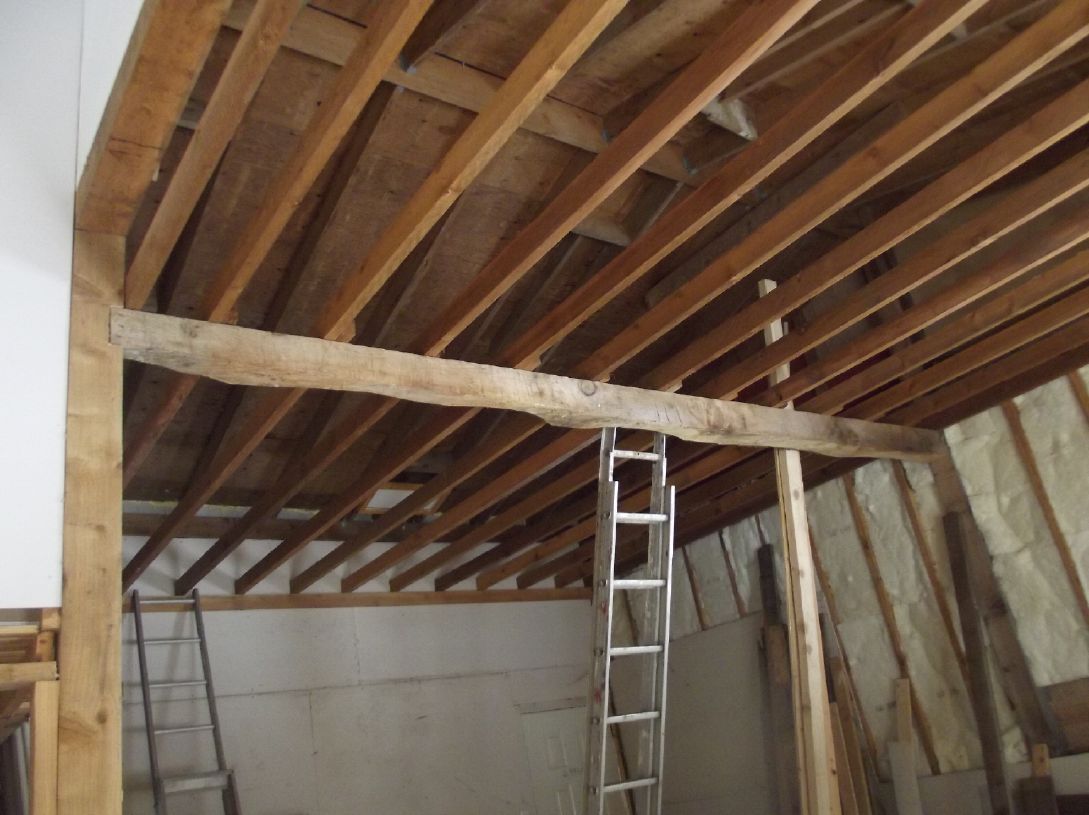 [10th] Using the end rafter to help get it level,
I put up the north end wall 2 by 4 board to support the other
rafters. I put up 6 of them.
[10th] Using the end rafter to help get it level,
I put up the north end wall 2 by 4 board to support the other
rafters. I put up 6 of them.
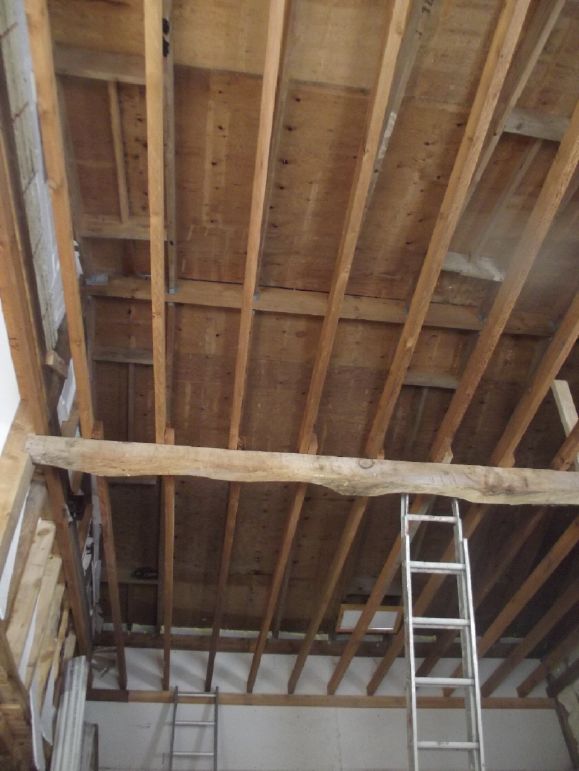 [11th] I changed the last double rafter on the
south end to single, seeing a better way to do the edge wall up to
the "cathedral" west ceiling by modifying it a bit. (Picture
barely shows it at lowest right corner) Then I put up the rest of
the rafters on the north side.
[11th] I changed the last double rafter on the
south end to single, seeing a better way to do the edge wall up to
the "cathedral" west ceiling by modifying it a bit. (Picture
barely shows it at lowest right corner) Then I put up the rest of
the rafters on the north side.
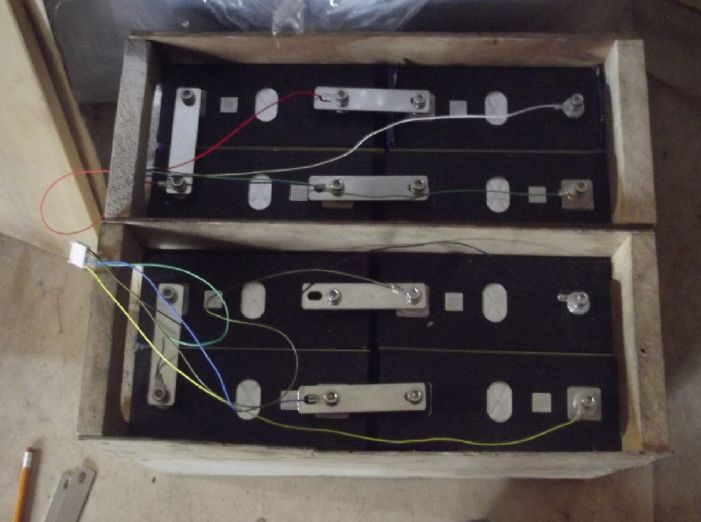 [22nd] I finally started wiring up the second set
of 36 V, 325 AH battery cells. I wanted to make it so I could take
away one or two 12 volt sets to use with 12 or 24 volt electric
outboards. I had previously made two wooden boxes with lids that
each held 4 cells for that purpose.
[22nd] I finally started wiring up the second set
of 36 V, 325 AH battery cells. I wanted to make it so I could take
away one or two 12 volt sets to use with 12 or 24 volt electric
outboards. I had previously made two wooden boxes with lids that
each held 4 cells for that purpose.
I dug out two old heavy plastic boxes meant for lead-acid
batteries. The last four cells can go two in each box. These ones
didn't have to transport.
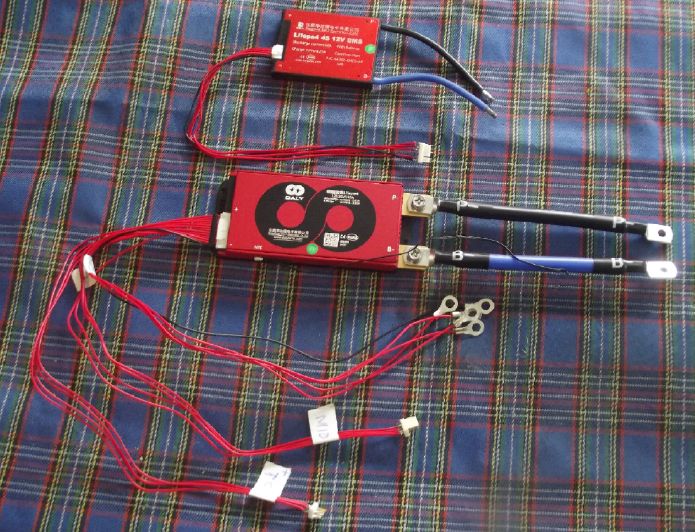 I realized I should make
the two boxes interchangeable as well as portable, so I wired all
five possible balance charger wire connections in both boxes. They
can be connected to the 36 volt, 13 sense wire "12S" balance
charger or each box separately to 12 volt, 5 sense wire balance
chargers.
I realized I should make
the two boxes interchangeable as well as portable, so I wired all
five possible balance charger wire connections in both boxes. They
can be connected to the 36 volt, 13 sense wire "12S" balance
charger or each box separately to 12 volt, 5 sense wire balance
chargers.
I intend to use 75 amp Anderson 'APP' connectors for
the power wires, but I see I don't presently have enough shells. I
do have enough pins. I can scrounge shells from other things and
replace them later.
I ordered some more. Wait, the plastic shells are "75
amps" but the pins that go in them are just "50 amps"!?! I've been
treating them as 75 amp units all along!
If used as 12 or 24 volt sets in a boat, the 36 volts
will be way out of balance when I bring them back. Hence, they
will be recharged separately as 12 volt batteries before
connecting them all back to 36 volts in the cabin again.
With ~600 AH at 36 volts in the cabin, I can run 500
or even 800 watts of 36 volt heaters overnight without fear of
loading them up too much or discharging down too far overnight. In
spring and autumn when there's enough solar energy in the days
(this overcast month full of snow excepted!), that should go a
long way toward reducing power grid power use, without needing to
keep a fire going in the woodstove all night. (Easier. Use
firewood in winter when it's really needed!)
I decided to wait for the new connectors. Also, I see
that now 600 amp-hour LiFePO4 cells are available. (Well, for the
next guy).
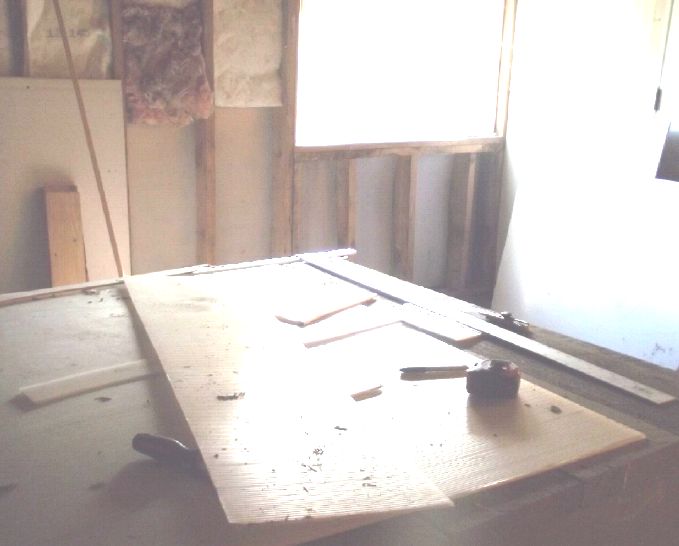 The east wall had had problems with
water getting into the wall - actually wicking in - at the bottom
of the alium wall panels. Last summer I took the metal cladding
right off and put in some flashing, but the birch (indoor rated)
plywood was already in tatters. I decided to take the gyproc off
the wall from the inside and stuff tight fitting pieces of
"coroplast" in between each stud space, going up the width of the
plastic, about 52 inches. I got one 8 foot section done out of
three, from the bottoms up and stuffed behind the insulation,
which I hadn't put in yet owing to this problem. So: two more 8
foot sections to go and then insulation and gyproc the whole wall.
The east wall had had problems with
water getting into the wall - actually wicking in - at the bottom
of the alium wall panels. Last summer I took the metal cladding
right off and put in some flashing, but the birch (indoor rated)
plywood was already in tatters. I decided to take the gyproc off
the wall from the inside and stuff tight fitting pieces of
"coroplast" in between each stud space, going up the width of the
plastic, about 52 inches. I got one 8 foot section done out of
three, from the bottoms up and stuffed behind the insulation,
which I hadn't put in yet owing to this problem. So: two more 8
foot sections to go and then insulation and gyproc the whole wall.
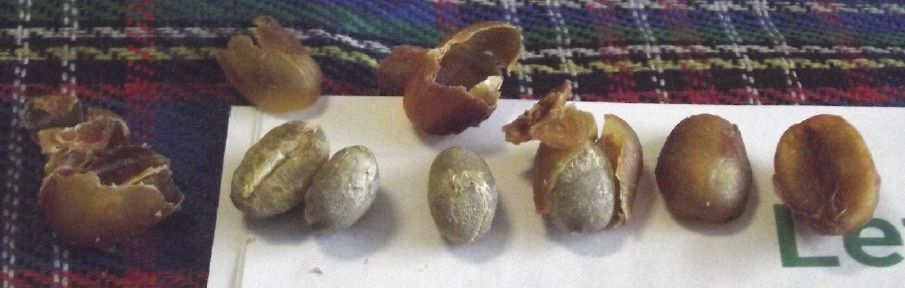
I hadn't used the coffee beans I had
grown. Why were they a sort of soft brown when beans one buys
are smaller, hard and white?
Finally someone showed me the secret. The squishy brown is a
middle layer - inside the skin but outside the actual bean!
I'm not sure I'd want to peel a lot of beans by hand and since
I'm not growing more I'm not looking up how it's usually done.
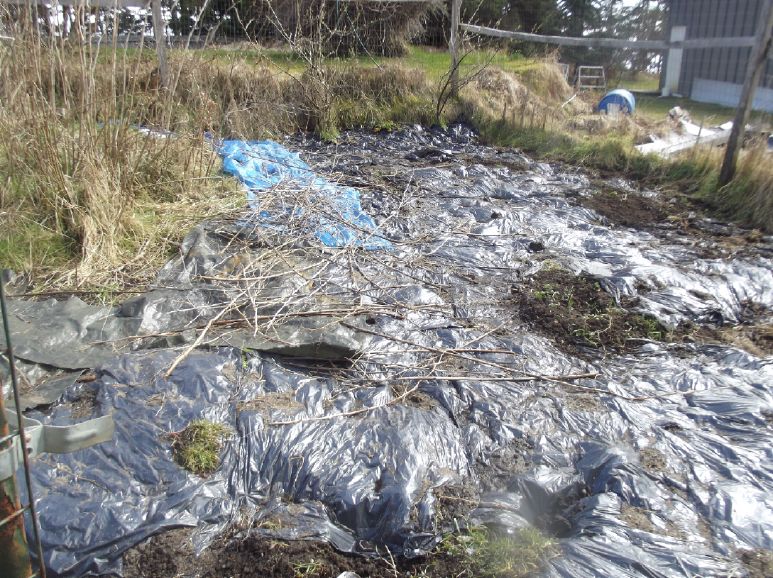 I bought more black garbage bags and
covered more of the main garden with black plastic. This time I
didn't slit them open so there are two layers. I had the thought
that one layer may not block the light sufficiently. I guess I'll
find out.
I bought more black garbage bags and
covered more of the main garden with black plastic. This time I
didn't slit them open so there are two layers. I had the thought
that one layer may not block the light sufficiently. I guess I'll
find out.
Then it started snowing. Must have been 8 to 10
inches over several days. Not January - March. Sheesh!
I had earlier thrown a decrepit plastic tarp off the
top of my shipping container. It wasn't keeping rain out or even
reducing condensation on the ceiling because many areas were
ripping apart. I had intended to cut it up and use it as fire
starter in the woodstove, but then I thought some of the more
intact areas might still make good garden ground cover and I
covered a fair chunk more garden. Then I thought about a couple
more dilapidated tarps in my cellar. I got one out intending to
cut it into cover patches too. But I was busy on the 20th and in
the next days wind howled, it poured rain and then snowed again.
The chickens scratched the bags away, so I had to
lock them out.
I started some onions, corn and pumpkins in 4 liter
milk cartons with their tops cut off. But given I spend my nights
in the cabin, the house isn't very warm. Some mold started growing
on the potting soil in one container. Really I'm way behind in
planting seedlings.
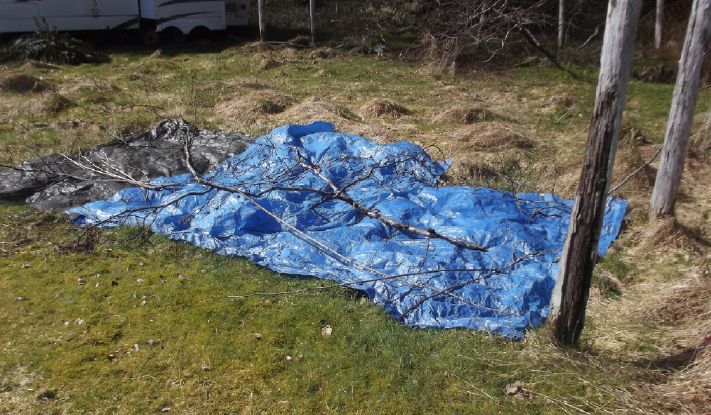 [26th] It wasn't until the 25th that it stopped
snowing every night. I cut up the blue tarp and covered some more
areas. If I resurrect this potato patch again I think I'll put a
fence around it. The deer eat the tops and the chickens dig up and
eat the potatos.
[26th] It wasn't until the 25th that it stopped
snowing every night. I cut up the blue tarp and covered some more
areas. If I resurrect this potato patch again I think I'll put a
fence around it. The deer eat the tops and the chickens dig up and
eat the potatos.
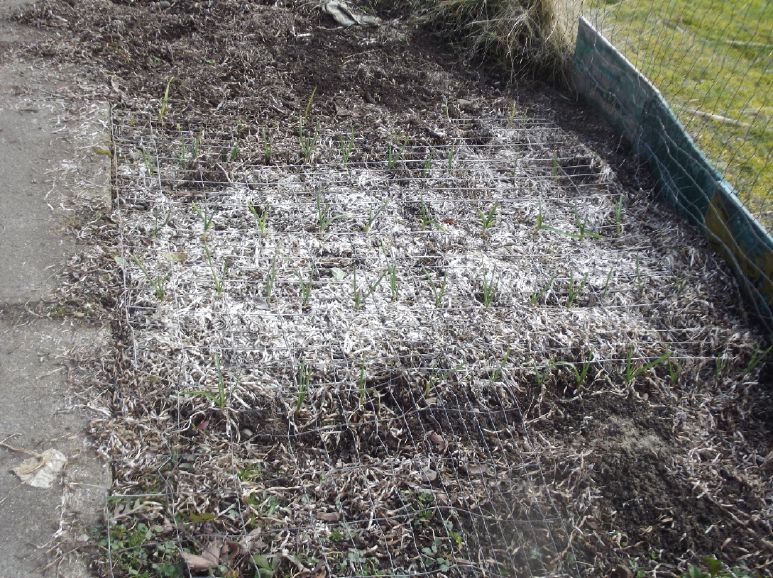
[29th] Garlic planted last fall
poking up through the eel grass mulch - and earlier, through
the snow.
The steel mesh keep the chickens from scratching it all up.
(Closest-up piece I had just put over the strawberries.)
The chickens do a good job of scratching up weed & bugs,
so I like
to let them in the gardens over winter until I'm ready for
spring planting.
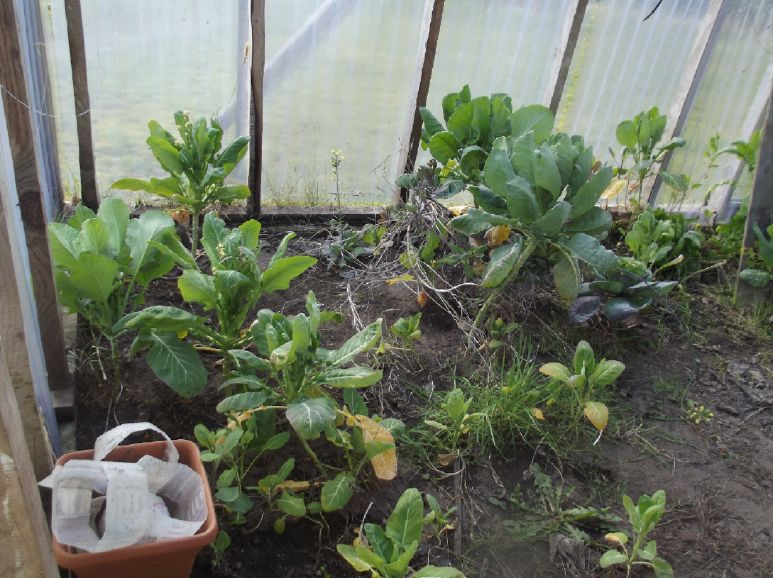
The left/east end of my greenhouse is full of self-seeded
cabbages, cauliflowers and broccolis.
To plant some in the main garden I just dig some little ones
up form here.
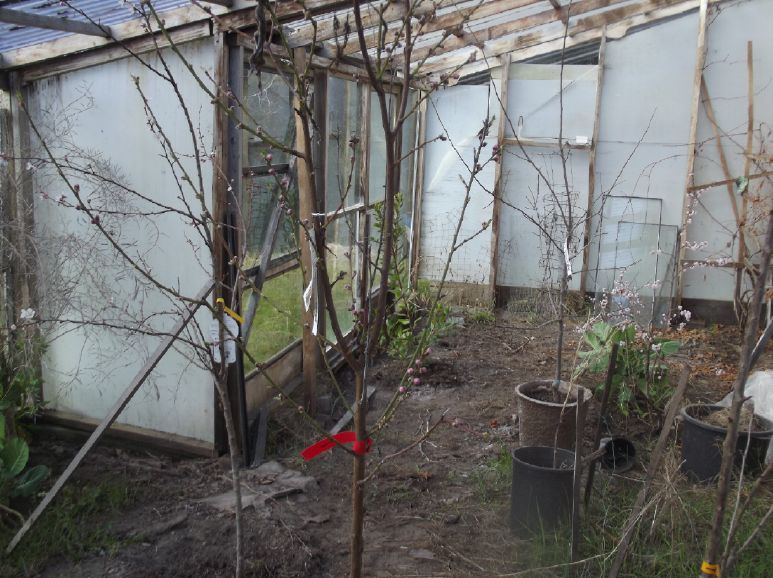
The rest mostly has planted and potted trees:
Grape Vine (far rt. corner), Strawberry Tree (green bush by
window), Plum (pot, white tag), Apricot ('bush', pink
flowers),
Apricot Tree (left, white flowers), Peach tree (pot, red
ribbon & pink flowers), and cherry (rt.front, yellow tag).
When the asparagus comes up, some things will have to go!
[6th, 7th] I made up a cell ready for
the new tall, thin pot. I stuffed the zinc into the pot fairly
strongly - and the pot broke. The bottom punched off, and the
sides broke pulling it out. Dang! The 90% sand, 10% clay porous
vessels just aren't very strong. In fact they're flimsy, brittle.
I thought of gluing it together with crazy glue, but I didn't seem
to have all the pieces. I really wasn't into making another one at
that time. I wanted to make a new cell.
Well, if the pots were so flimsy perhaps the fat
round one could be ground down? It did grind down, and even file
down, easily. But it wasn't very tall, and I didn't really dare
try to make it as thin as the other. So the prepared separator
paper didn't fit. I pulled the paper out of the Ni-Zn #1 cell,
which I hadn't tried using since making the improved Ni-Zn #2.
I cut it a bit to fit, then remembered that it would
only have the osmium dopant on the inside, since the nickel
electrode didn't need it. It looked a bit too suspect to want to
paint the outside. So I decided to go with NiMn-Zn instead of
Cu-Zn since copper gets soluble cuprate ions. Then I started
wondering why I was bothering. What might this sell show that
wasn't already shown? I left the top open so I could stuff more
NiMn2O4 oxide in to check the effects of compaction - and
decompaction.
[13th] Back to it... It wasn't working. Pressing some down with a
small slot screwdriver helped momentarily. Surely I had to compact
the NiMn2O4 mix, and then add some more to fill again. How? I cut
a piece of thin sheet metal and bent it to go around the pot &
paper. That way I could put substance in around the outside of the
metal, compact it without damaging the paper, and then withdraw
the metal. I made a couple of pieces of al[umin]ium to press the
powder in with.
The first part worked okay. I put in some powder and
pressed it in. But when I went I went to withdraw the piece of
metal, the bottom of the pot broke off and the rest came out with
the metal.
Back to the drawing board yet again!
Organic Copper-Zinc Again
Okay, let's modify the
earlier plan. Instead of an inner and outer basket, have the
rather brittle inner sand & clay ceramic pot, the multiplely
treated paper, and an outer basket or sleeve. The outer electrode
mix would be compacted in the ring between the outer basket
(inside) and current collector (inside outer wall of jar). Some
would squeeze through the perforations in the basket against the
paper, while the pressing device would be between the basket and
the outer sheet current collector and never directly press on or
abrade the paper. If the pressing device pushed with fairly
uniform pressure all the way around, the basket should take it and
protect the paper and the brittle ceramic with the zinc filled
center hole. Then it's done. The basket stays in place avoiding
removal stress. It's superfluous once the cell is complete, but
allows for safe assembly with good compaction of the "+" electrode
including pressing it against the paper.
No doubt there are other ways. For example a machine
minutely and precisely moving the protection piece and the
pressing piece both up bit by bit as more and more powder was
added, gradually filling and compacting material from bottom to
top. I haven't found a good way yet for prototyping. This one
should work for test cells and perhaps for production.
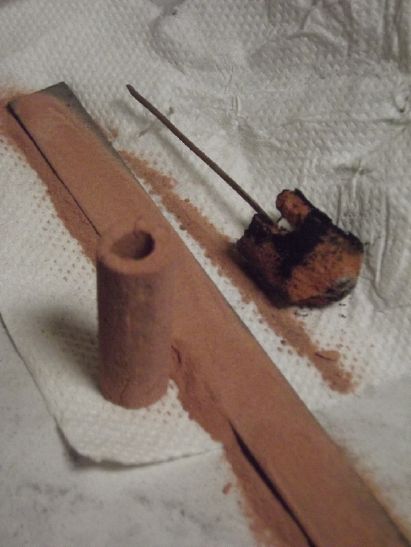 I made another of the tall, thin pots
with the same mold. The paper didn't go all the way around, so
having earlier found it was easy, I simply filed it down to a
smaller - and more uniform - diameter. This gave me the idea that
to get uniform size in production, the pots would simply be made
slightly oversize and run through a sander of some sort that trims
them to size. (The broken pot is also shown.) Then I set it in
melted wax for a moment to make the bottom impermeable for below
the paper.
I made another of the tall, thin pots
with the same mold. The paper didn't go all the way around, so
having earlier found it was easy, I simply filed it down to a
smaller - and more uniform - diameter. This gave me the idea that
to get uniform size in production, the pots would simply be made
slightly oversize and run through a sander of some sort that trims
them to size. (The broken pot is also shown.) Then I set it in
melted wax for a moment to make the bottom impermeable for below
the paper.
Next the outer basket had to be made to fit nicely
over the pot and paper. It looked like that would be about the
size of my "inner basket" of the latest basket design. Manyana!
[14th] I printed three versions of the basket. The last one fit
well and the wall wasn't too thick. (I started to think that a
thick wall would impede the "+"trode mix from filling the
perforations, which is necessary for a dry cell. I gave it a rim
at the bottom to cover the entire bottom of the jar. Since this
basket didn't have to be impervious I also did a hole to
accommodate the center bump in the bottom of the jar, so it would
sit flat.
I fitted the new pot into the basket with the paper
(osmium'ed on both faces) in between.
It turned out well that I had made the full bottom
rim, because pulling out the 3/4 inch copper pipe that I used to
compact the outer electrode mix took some force. To keep the
assembly from sliding out with the pipe I had to hold it down.
Because of the extended bottom I could press on the silver sheet
current collector (with a screwdriver blade) instead of on the
center ceramic. I'm sure that fragile piece would have broken.
[15th] I took apart a previous cell (Ni-Zn #1) for the jar and
another one to get its silver sheet current collector. (I already
broke that jar.) I put the basket assembly in. I cut some graphite
gasket to the same height as the silver and wrapped it around
inside the jar to shrink the effective outer diameter.
Inside of that the silver sheet was about the right
diameter gap to fit outside a 3/4 inch copper pipe while the
basket fit just inside. (I was lucky to end up at a size where a
pipe fit so well for compacting the organic monel mix.)
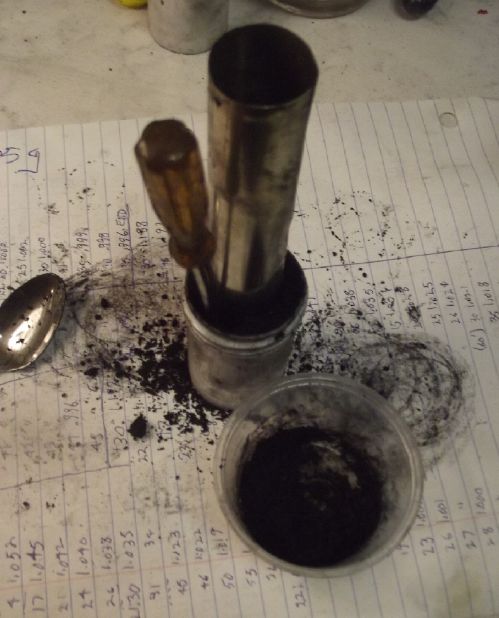 That mix ended up
roughly as the previous monel mix plus 5% (or was it 1%?) silver
oxide, plus an added 13 wt% conductive carbon black ("CCB")
to make it more conductive, which lightweight material added a lot
to the volume.
That mix ended up
roughly as the previous monel mix plus 5% (or was it 1%?) silver
oxide, plus an added 13 wt% conductive carbon black ("CCB")
to make it more conductive, which lightweight material added a lot
to the volume.
I weighed out 27.5 grams in a lightweight PP ketchup
tub (counting the tub). Then I started spooning in the mix. I
rolled up a thin piece of sheet metal as a tube to keep it away
from the center basket, but it was thin enough to leave a slot for
the mix to go in. I had turned the powder into a paste to mix in
the CCB. Dry powder should have gone in more easily.
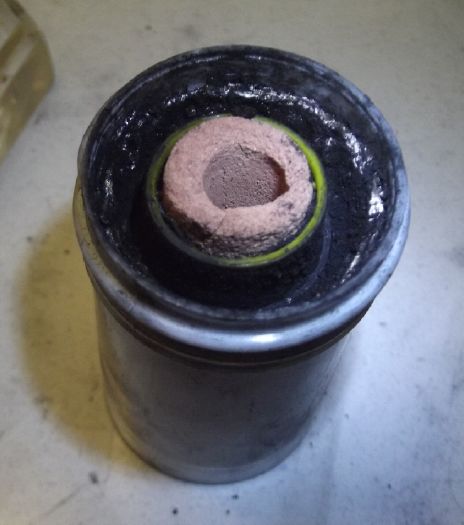 I stopped about 1/4 inch from the top
of the basket. The tub with remnant powder weighed about 6 grams.
With a bit of spillage there should have been about 20 grams of
material. A few amp-hours for sure.
I stopped about 1/4 inch from the top
of the basket. The tub with remnant powder weighed about 6 grams.
With a bit of spillage there should have been about 20 grams of
material. A few amp-hours for sure.
Then I funneled in zinc powder. This mix was zinc
powder (pretty fine but coarser than the other) plus zinc flakes
(so fine they floated into the air when disturbed) plus ~~1/2%
zircon to improve hydrogen overvoltage. I tamped them in gently. I
wanted to push it in harder but I've already broken two of the
sand & clay 'ceramic pots'. Then I dug in the copper wire
current collector to the bottom, twisting it back and forth, and
tamped around it again. It was probably only around 6 grams of
zinc, which should be a match for 12-15 grams of the coppery stuff
- less than the 20 I had put in. What are the chances now of
getting at least a couple of amp-hours from it instead of x10's of
milliamp-hours?
Finally I jabbed in a long silver sliver terminal
behind the outside of the silver sheet current collector and added
some electrolyte consisting of the latest mixture:
Water: 100 grams
KCl: 10 grams
KOH: 6 grams (5g was minimal to get up to pH 13 so it could turn
zinc to zincate)
NaCl: 1 gram (some sodium for the copper chemistry?)
Na2SO4: 2 grams (I tried 5g but much of it didn't dissolve or
settled out as a solid later)
It seemed like a pretty damp dry cell with 5 cc
added.
One thought was to pour wax over the top and seal it.
Another was that it's still a test cell and I might want to get
into it. I put the modelling clay cover over it.
I hooked it up. The meter had a poor connection and
wasn't showing the voltage right. I set the power supply to 5.0
volts and connected it. The current was only 3 mA. Now it was
apparent that the cell voltage was reading wrong and I fixed the
connection.
The low charge current seemed less than promising.
But when I hooked up a load it put out, even without any
significant charging. It did drop over several seconds, but for
short tests it ended up doing something like:
30 ohms: 1.0 V, 30 mA
20 ohms: .9 V, 42 mA
10 ohms: .7 V, 51 mA
There's the 2 ohms in the ampmeter shunt and
apparently more resistance in the test leeds and alligator clips,
because the current didn't match the resistance and voltage,
especially for the 10 ohm load.
After some short tests the charging current went up
over 6, then 8, mA.
A couple of hours later I tried again. Charge current
was up to about 12 mA. But load currents were down instead of up!
Copper degrading tricks again? I pulled the modelling clay off the
top and squirted in a bit more electrolyte. That brought it back
up again - it was just getting too dry. Probably more of the
liquid had absorbed into nether spaces of the cell, eg, inside the
wraps and around the edges of the graphite gasket spacers. The
same tests now gave:
30 ohms: 1.05 V, 34 mA
20 ohms: .95 V, 44 mA
10 ohms: .75 V, 65 mA
These figures were now in approximate line with 2
ohms for the meter shunt for real resistances of 32, 22 and 12
ohms. Oh ya!... and the cell was getting stronger with charging
per expectations and hopes. I upped the charge voltage to 1.60 V.
I'm not sure 1.5 is really enough in this chemie that needs more
exploration. (That's why I made the cell, right?) I left it with
charge current in the mid teens of mA.
[16th] The cell didn't seem to have much performance. Adding
electrolyte helped a little the first time, but not afterward. It
sits at over 1.4 volts after charging but drops below 1.3
immediately, 1.2 in seconds, and below 1.100 volts in about 100
seconds with just a 50 ohm load.
[17th] Still no better. Having left the cell accessible I tried
pressing down on the "+" electrode paste some more with the pipe.
It didn't compact much and it didn't work better afterward. More
electrolyte left a bit of liquid on top, so it didn't need that. I
didn't know what the problem was. I was about ready to give up on
copper hydroxides and go back to nickel manganates. (If not to
nickel oxyhydroxide -- that substance taken from Ni-MH dry cells
was consistently the best performer so far.) Was there anything
else I could try first?
pH! I checked the pH of my jar of electrolyte, which
was nearly empty. It seemed to be below 13! The zinc (if not the
copper) has to be 13+. I've been using the same jar for many
moons. Most likely explanation: I was repeatedly opening that
sealed jar to get electrolyte. As it gets lower, KOH takes the CO2
from the air in the jar and gradually converts to carbonate, KCO3,
which is not alkaline and not good electrolyte. (And what about my
dry KOH powder, also getting low in a jar that gets opened once in
a while?)
So the pH of the cell with that electrolyte must also
be below 13. I sprinkled 1/2 a gram of KOH into the cell and then
squirted a little water onto it so it would dissolve.
After an hour's charging the drop under load slowed
markedly at about 1.15 volts and it lasted 6 minutes before
dropping below 1.10 volts - 360 seconds instead of 100. Certainly
the pH had a role. Still nothing like performance or energy
storage! Well... more charging.
Later on I tried again a couple of times, and it
started above 1.3 volts for a few seconds and took 30, then 40,
seconds to drop to 1.2 volts. It looked like dropping to 1.100
volts would take quite a long time now and I was trying to charge
it, not discharge it. So I stopped at 1.200 instead.
[18th] Raising the pH helped, but it doesn't seem to be what it
should be. What else? I dropped in a few grains of white sugar
(sucrose). That may have helped a tiny bit too. Or was it just the
longer charging? But everything seemed to deteriorate again and
good output was not maintained.
[20th] Having left the top accessible I took a piece of metal and
pressed down on the outer electrode substance. Perhaps it
wasn't compressed enough? It worked worse!
[21st] Maybe if copper was to charge to soluble cuprate ions it
needed extra space for them, like the zinc did for the zincate? I
scooped everything out and put it all back in with much less
compaction - 15 grams instead of 20 filled the space. It still
didn't seem to work.
[22nd] Nothing seemed to give it anything like the performance of
the cupro-nickel sheet metal. But that always worked great a
couple of times and then degraded and wouldn't perform, too.
Really I was getting similar results, at best.
I had raised the charging voltage from 1.5 to 1.6.
And then 1.8. It didn't seem to help. It just didn't seem to
charge or perform except to deliver way under a volt at low
current. If the charge voltage was any higher I'd be charging the
nickel in the monel to nickel oxyhydroxide. (It would already be
charging the surface of the silver to silver oxide.) But maybe
oxyhydroxide would alter the "solid solution" balance in the monel
and have some beneficial effect? I raised it again to 1.95 volts.
That seemed a little strange for a cell of around 1.2 volts. But
I'm grasping at straws. I'm about ready to give up on copper
anyway and go back to nickel manganates electrodes, which seem to
work quite well.
No help. Instead I drained it down to a very low
voltage and then charged it back up. This time it was a little
better. I gave it a 7 ohm load and left it to drain right down
overnight. But it seems to me I've been down this road before. It
works better, then charge it longer and it's worse again.
[23rd, 24th, 25th, 26th, 27th] I thought about the deep discharge.
In the monel, the copper turns into copper (I) hydroxide at about
-.25 volts. nickel turns into nickel hydroxide at -.6 volts. If
the zinc is overpowering the plus side, it is sitting at about
-1.2 volts. So if the cell voltage is down to .95 volts (with the
zinc at -1.2), the copper substance will be down to -.25 and
turning metallic again, and at .6 cell volts the nickel will be
down to -.6 volts and turning into metallic nickel particles
again. The monel started out as micro powder, but as the nickel
and copper are charged to hydroxides they are likely to disperse
some into the thyamine and carbon black. (Especially if not too
tightly compacted.)
So what happens when they are discharged to Ni &
Cu metal and then recharged to hydroxides again? Do the monel
granules break up into fuzzy "solid solution" blobs in the mix?
(...And what happens to the thyamine and the CCB?)
I decided to discharge the cell down to 0.000 V and
0.0 mA through a ten ohm resistor. It ran overnight and all day on
the 14th. It was down to under 1 mA at one point, but when next
checked it was up to 1.6 again. So it ran a second night. and a
third. One time on the 26th it was up to 2.6 mA, but after that it
stayed under 1, and on the morning of the 27th I put it back on
charge at 1.60 volts.
It didn't help. It still pulled its same tricks -
never going back up to the initial highly promising 1.3 volts
under load, and discharge voltages in fact getting lower and lower
the longer it was charged.
Metal Organic Frameworks ('MOF's)
[25th] I watched a video about 'Metal Organic Frameworks'
('MOF's), which I had never heard of. A heterogeneous lattice is
formed with nano metal ion centers (eg, 2-3 nanometers) connected
by organic ligands. The nano-scale structure is mostly empty space
with a very high surface area. Some formulations are conductive.
That could allow electrolyte penetration throughout and hence very
high utilization of the active metal ions - ideal for a battery
electrode. Of course I looked up further info. There are a zillion
'MOF' possibilities for different purposes such as water
filtration, capture of water from the air, and supercapacitors.
'Battery electrodes' was in fact specificly discussed
in one writeup. So were amines as organic ligands. It sounded like
just the sort of thing I've been vaguely groping for with the
organic copper-nickel-thyamine(baked beans)-CCB mix. (Thiamine
does contain an amine group. Beyond that the chemistry and
morphology is beyond me.)
MOF with Manganese?
Manganese seemed a better "+" atom than copper.
Adding nickel to make it rechargeable, making it into nickel
manganates, works well to make perfectly acceptable batteries, but
the considerable nickel component dilutes the energy stored per
weight.
Now it occurred to me that while Mn2O3
(or is it MnOOH?) by itself is an insulator that won't recharge to
MnO2, Mn3+ bound up in a conductive
nano-lattice might well recharge to Mn4+. The organic
component would be much lighter than nickel additive as well as
ensuring excellent electrolyte penetration for maximum Mn
utilization. If organic-manganese 'MOF' would work well, why would
I bother with organic-copper/monel 'MOF', which has proven quite
troublesome so far, has soluble ions and is also energy diluted by
monel's nickel content? Except for rechargability manganese works
so well in ordinary dry cells! I should certainly try the organic
mix idea with plain manganese.
[27th] I made a new sand-clay pot and a new outer basket, then
soaked a toluened paper in SDBS. Then painted
osmium-in-acetaldehyde dopant on the inside face.
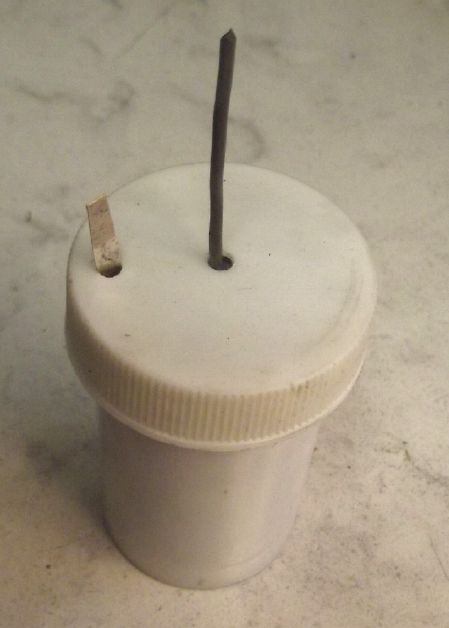 I though of a good way to put the lid
on the ointment jar battery: Drill the center hole (-) and the
outer hole (+) with a small drill. Slip the center hole over the
copper wire terminal and screw it on. THEN stick the silver "+"
terminal wire (or long thin piece of sheet metal) through the hole
and jab it into the outer graphite foil current collector, since
it can go anywhere around the outer perimeter. Presto!
I though of a good way to put the lid
on the ointment jar battery: Drill the center hole (-) and the
outer hole (+) with a small drill. Slip the center hole over the
copper wire terminal and screw it on. THEN stick the silver "+"
terminal wire (or long thin piece of sheet metal) through the hole
and jab it into the outer graphite foil current collector, since
it can go anywhere around the outer perimeter. Presto!
I also was concerned about the silver, as it
gets more expensive. I won't use any inside the cell. I
expanded/thinned a minimal piece of sheet to use a terminal wire.
It stuck in without buckling and stuck out 1/2 an inch. It was
only 1/4 of a gram! (Even that's over a dollar's worth now!)
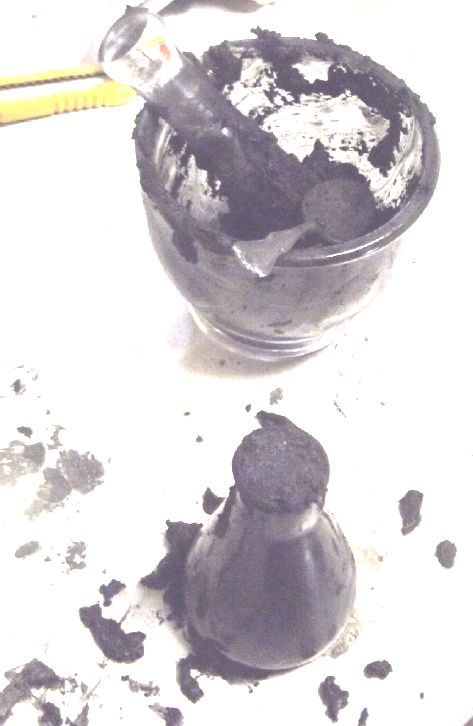 [28th] I spooned out some MnO'x' substance taken
from 'D' cells long ago. It was in lumps so I crushed it down with
mortar & pestle. That decompacted the lumps so the powder
actually expanded. It ended up as 39 cc, 72 grams. I got the same
can of beans previously used with the organic-monel experiments
from the freezer and used 60 cc, which was about 77 grams. I mixed
them thoroughly in the mortar with the pestle to a vile looking
black goop.
[28th] I spooned out some MnO'x' substance taken
from 'D' cells long ago. It was in lumps so I crushed it down with
mortar & pestle. That decompacted the lumps so the powder
actually expanded. It ended up as 39 cc, 72 grams. I got the same
can of beans previously used with the organic-monel experiments
from the freezer and used 60 cc, which was about 77 grams. I mixed
them thoroughly in the mortar with the pestle to a vile looking
black goop.
I filled my [one and only] little flask to the brim
using about 90% of this substance, and put it in the oven at
500°F. Since it was so full I left it for 20 minutes. When I took
it out steam pressure inside had ejected much of the content as a
"mud volcano". It was all dry and in big lumps or caked to the
sides of the flask.
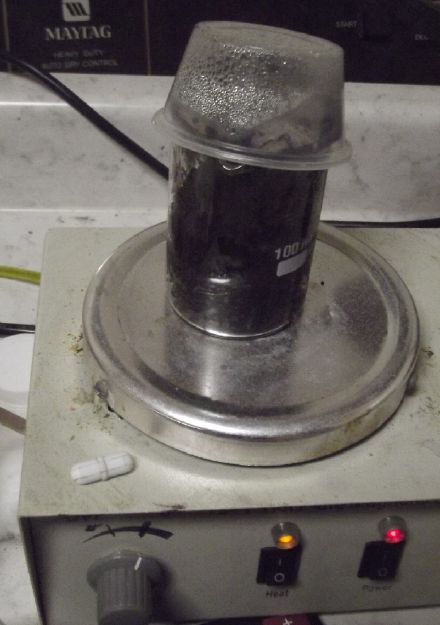 Then I ground it all to
powder. I added 14 grams of white sugar (sucrose) and enough water
to make it back into a paste. I put the beaker on the hotplate and
heated it to 60°C for about 4 hours.
Then I ground it all to
powder. I added 14 grams of white sugar (sucrose) and enough water
to make it back into a paste. I put the beaker on the hotplate and
heated it to 60°C for about 4 hours.
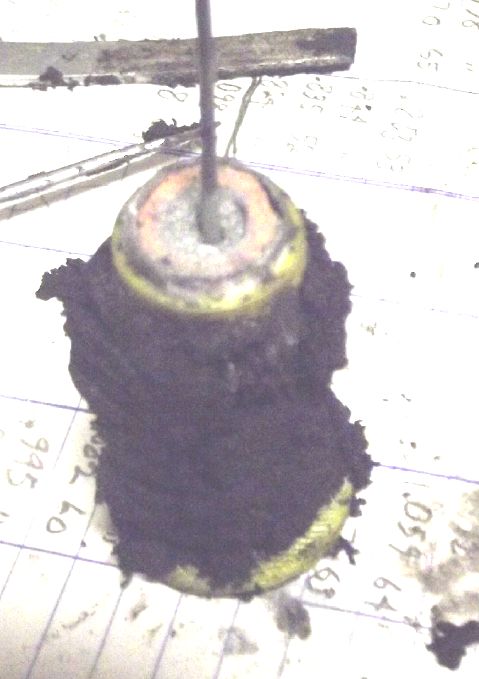 I squeezed paste into the
perforations in the outer basket both to ensure they were filled
and to have less stuff to stuff into the narrow gap of the
electrode space. Then I put the basket and outer graphite sheet
current collector into the jar. I probably stuffed in about 25 or
30 grams of the paste - far too much to balance the 5 grams of
zinc. By then it was late.
I squeezed paste into the
perforations in the outer basket both to ensure they were filled
and to have less stuff to stuff into the narrow gap of the
electrode space. Then I put the basket and outer graphite sheet
current collector into the jar. I probably stuffed in about 25 or
30 grams of the paste - far too much to balance the 5 grams of
zinc. By then it was late.
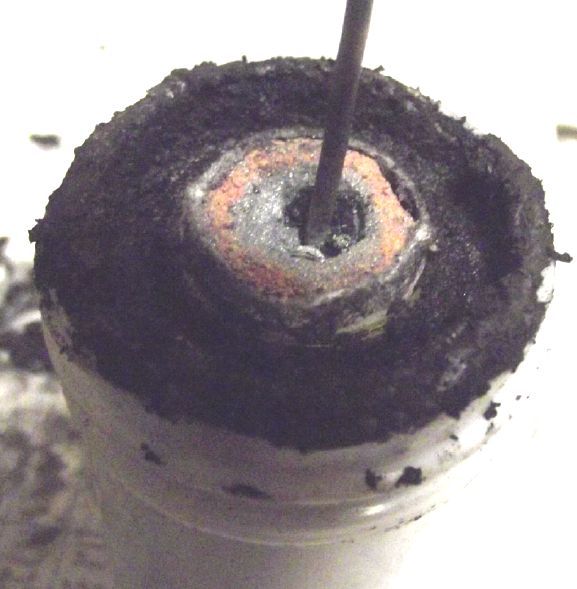 [29th] I squirted in some electrolyte. Still "dry
cell" but pretty saturated looking. I screwed the cap on then
stuck in the silver outer electrode.
[29th] I squirted in some electrolyte. Still "dry
cell" but pretty saturated looking. I screwed the cap on then
stuck in the silver outer electrode.
It started of charging at only .6 mA. After a while
it was 1.6, but it didn't seem to rise any further.
Over the day it dropped to 1.2 mA. The voltage under
50 ohm load crept up gradually to almost 1/4 volt.
[April 4th] Over the days 50 ohm load gradually crept up through
.3 volts to .4. The conductive MOF type structure seems to
be forming itself with a 1 mA charge, but over geologic time.
As of early April I'm mixing up a nickel MOF. If more
amp-hours can be squeezed out of the nickel in a MOF structure
than as nickel oxyhydroxide, good amp-hours and about 1/3 of a
volt higher voltage should be even better. (And I've certainly got
the best performance of anything from Ni-MH dry cell Ni
substance.) And I expect a MOF electrode doesn't need to be
compacted (and held compacted) with the tons of force that a
nickel hydroxide electrode needs.
I think I made a mistake using manganese oxide. This
time I'm using nickel metal powder ('fluffy' flakes), not nickel
oxide powder. Why would a metal oxide readily convert to a metal
centers - organic ligands structure? It's already a metal oxide
structure. It would have to decompose and recompose to the new
configuration.
Electricity Generation
My (Old & New) Solar Power System(s)
(My solar panels recent images - TE News #213)
Double Battery in the Cabin -
& for Boats
[23rd] Quite a while back I bought another twelve 325 AH LiFePO4
battery cells and a 150 amp, 12S balance charger. I had thought
they would be great in the electric Sprint car, but so far I
haven't liberated any more time to continue working on the
fabulous unipolar axial flux BLDC
motor for it that I started on so long ago. So! Last summer I had
put two sets of four into wooden boxes with carry handles to make
them portable. But I've decided to use them in the cabin to double
the storage, and to disconnect them and carry them out to the boat
if and when I wanted to run an electric outboard. (There are now
600 amp-hour LiFePO4 cells available. A 36 volt set of those would
give an "ultra-efficient" Sprint substantially farther driving
range than the Nissan Leaf.)
Now I put the third set of four into two plastic
boxes I had lying around, intended for lead-acid batteries. (Two
fit in each box.) I wouldn't need more than 24 volts, so these
last ones could be hard wired in the cabin and never be pulled
out.
I finally got around to starting to wire them up.
Anderson APP connectors seemed to be the practical solution. I
didn't have enough and I ordered a bunch of 50/75 amp pins and
shells in three colors. I wanted to be able to use either wooden
box with a 12 volt outboard, so they had to be the same. Otherwise
it would have been better to use different connector shells so
that everything would only fit one way into the 36 volt system. I
put a 400 amp fuse between two cells of both boxes.
The skinny balance charger wires also had to be a
quick disconnect and reconnect. I did 6 pin header connectors with
plastic pin alignments. Each box needs four connections to the 12S
balance charger, but five (with ground) to a 4S balance charger
for separate recharging to 'balanced' before putting them back
into the 36 volt system after boat use. I pulled one pin out of
each socket with pliers. Even aside from the alignment locking, it
was easy to see where the missing pin and wires lined up. (And
made sure I hadn't wired the plugs and sockets mirror imaged.)
Still I would have to be very careful to connect them
properly when they were brought back to the cabin and reconnected.
If I ever get the two sets of balance wires swapped it would
probably fry the balance controller. I used white tape to label
the ones from the balance charger "MID" and "TOP".
The Usual Daily/Monthly/Yearly Log of Solar Power Generated
[and grid power consumed]
Notes:
* All times are in PST: clock ~48 minutes ahead of local
sun time, never PDT which is an hour and 48 minutes ahead.
* Unapproved AC/Grid Tied systems have been removed.
* House panels include four old ones on the roof (upper - total
rating ~ 1000W), two 305W on the roof, three 305W on the south
wall below the roof, and one broken panel mounted verticly on the
porch railing (seems to still work but a lot of shade there).
* Cabin DC includes the three carport panels and the two on a pole
in the yard as well as the four on the cabin roof itself. All nine
are 305W.
* The wall, pole and porch panels are easily wiped off from the
ground if it snows.
* Km = Nissan Leaf electric car drove distance, then car was
charged. Car KWH does not add to or subtract from any other
readings.
House System Panels: House roof, wall (9 solar panels) -
Porch (1 broken one - usually shady)
Cabin System Panels: Carport (3 - sunniest place on the
whole property) - Pole (2 - shadiest place) -Faraday Cabin (4 -
badly shaded in winter)
Date HouseDC,CabinDC,ACtoGrid =>
Total KWH Solar [grid use; etc.] New daily order as of December
6th 2025.
February
28th 1201.27, 909.38, 329.27 => 20.04 [37647@21:30]
March
1st 1203.30, 911.50, 345.61 => 10.49 [37675@'24:30']
2d 1205.11, 913.30, 340.39 => 8.39
[37724@22:30]
3rd 1208.40, 916.34, 351.05 => 16.99 [37768@22:00]
-- 2 days --> 16.16 /day
5th 1215.25, 922.17, 370.67 => 32.30 [37815@19:30]
8th to 14th: SNOW, SNOW, SNOW!
-- 4 days --> 11.44 /day
9th 1224.39, 931.12, 398.32 => 45.74 [37987@18:00]
10th 1225.79, 933.67, 400.75 => 6.38
[38038@'24:30']
11th 1227.34, 935.63, 407.03 => 9.79 [38071@19:00]
MOR snow in AM. Snow partly slid off solar panels by evening
(again). Some panels clear.
12th 1228.74, 938.26, 415.26 => 12.26 [38121@23:30]
13th 1231.51, 941.45, 427.56 => 18.26 [38144@19:00] MOR snow!
(& hail) Must've had a foot this month by now.
14th 1236.07, 945.19, 445.95 => 26.69 [38186@21:30] Sunny for
part of the day! (for once!) A bit of sleet.
15th 1237.09, 946.42, 449.27 => 5.57 [38231@23:30] High
winds, overcast, rain, +3 degrees (heat wave!)
16th 1240.01, 949.10, 460.34 => 16.67 [38259@21:30]
-- 2 days --> 17.58
18th 1247.38, 955.43, 481.80 => 35.16 [38345@?]
19th 1250.69, 958.61, 494.04 => 18.73 [38379@19:30]
20th 1255.93, 962.48, 515.31 => 30.38 [75Km; 38404@18:30] SUNNY
& nice! Most snow melted.
21st 1258.83, 965.69, 528.66 => 19.46 [38456@23:30] Wind, rain
& sleet!
22nd MOR Snow!
-- 4 days --> 21.07
25th 1275.21, 979.83, 582.42 => 84.28 [38599@21:30] yet more
snow, every night, which now mostly melts during the day.
-- 4 days --> 25.80
29th 1296.90, 996.46, 657.31=>103.21 [38756@21:30] What, no
snow this morning?
30th 1302.22,1000.85,661.78 => 13.60 [38793@23:30]
31st 1304.47,1003.05,667.86 => 10.53 [38823@19:00]
April
1st 1310.31, 1007.82, 695.36 => 38.12 [38847@19:30]
Sunny! (It shows!)
2d 1315.88, 1012.18, 710.14 => 24.71 [38873@19:30]
3rd 1321.28, 1017.13, 733.66 => [38908@'24:30']
4th 1326.01, 1021.87, 752.01 => [38924@'24:30']
5th 1330.36, 1026.00, 764.80 => [38944@19:30]
6th 1338.05, 1032.41, 793.32 => 42.62 [38966@'24:00']
Sunny. Now there's some serious electricity generation!
7th 1344.72, 1038.57, 819.85 => [38987@19:30]
8th 1350.29, 1044.63, 841.64 => [39015@'24:00']
9th 1357.59, 1051.23, 872.46 => 44.74 [39036@'24:00']
Sunny again.
Chart of daily KWH from solar panels. (Compare this
month with last month and with this month last year.)
Days of
__ KWH
|
March 2026
(38 solar panels)
|
February 2026
(the 18 old
collectors + 20 new)
|
March 2025
(18 C's - DC/
batteries only)
|
0.xx
|
|
|
|
1.xx
|
|
1
|
1
|
2.xx
|
|
|
4
|
3.xx
|
|
|
|
4.xx
|
|
1
|
2
|
5.xx
|
1
|
1
|
5
|
6.xx
|
1
|
7
|
6
|
7.xx
|
|
|
5
|
8.xx
|
1
|
1
|
3
|
9.xx
|
1
|
4
|
2
|
10.xx
|
2
|
7
|
2
|
11.xx
|
4
|
|
1
|
12.xx
|
1
|
1
|
|
13.xx
|
1
|
|
|
14.xx
|
|
|
|
15.xx
|
|
3
|
|
16.xx
|
4
|
|
|
17.xx
|
2
|
1
|
|
18.xx
|
2
|
|
|
19.xx
|
1
|
|
|
20.xx
|
|
|
|
21.xx
|
4
|
|
|
22.xx
|
|
|
|
23.xx
|
|
|
|
24.xx
|
|
|
|
25.xx
|
4
|
|
|
26.xx
|
1
|
|
|
27.xx
|
|
|
|
28.xx
|
|
|
|
29.xx
|
|
|
|
30.xx
|
1
|
|
|
Total KWH
for month
|
535.46
|
313.54
|
|
Km Driven
on Electricity
|
850.9 Km
@75. Km/Kwh
= 110 KWH
|
743.5 Km
@7.4 Km/KWH
= 100 KWH
|
|
Things Noted - March 2026
* Cold and snowy month.
* With 7 KW of new grid tied panels, March solar generation looks
as good as most previous good summer months.
Monthly Summaries: Solar Generated KWH [& Power
used from grid KWH]
As these tables are getting long, I'm not repeating the log of
monthly reports. The reports for the SEVEN full years (March 2019
to February 2026) may be found in TE
News #213, February 2026. Note that in November 2024 I had
to disconnect the "unapproved" solar power systems from the power
grid, and I have been running them as two "off grid" 300 amp-hour,
36 volt, battery systems since.
2024
Month: HouseAC + DC +Carport+Cabin[+DC] (from Aug 2024)
Oct KWH 78.48+ 7.29 + 64.39 + 7.52 + 40.75 =
198.43 [grid: 711; car: 120*]
Nov KWH 19.63+12.19+ 23.90 + 3.35 + 25.62
= 84.69 [grid: 900 (ACK!);car: 110*] Changed
solar
system to "off grid only" on 18th.
Now solar is charging
batteries only. Two 36 V DC systems: house, cabin, each 10
KWH, each 9 solar panels once wired.
Dec KWH 20.37 + 16.76 = 37.13 [grid: 1866 (using electric
heat - awg!); car: 120*]
2025
Jan KWH 35.02 + 26.30 = 61.32 [grid: 2136 (electric
heat OW!); car: 120*]
Feb KWH 55.43 + 39.00 = 94.43 [grid: 1937; car: 100*]
SIX full Years of
solar!
Mar KWH 115.13 + 87.41 = 202.54
[grid: 1860; car: 155* KWH]
Apr KWH 126.25 + 120.36 = 246.61 [grid: 1246; car: 100*]
May KWH 147.08 + 186.24 = 333.32 [grid: 1354; car: 150*]
Jun 145.58 + 170.97 = 316.55 [grid: 959; car: 130*]
July 156.48+ 86.78 = 243.26 [grid: 653; car 130]
Aug 118.56 + 48.50 = 167.06 [grid: 616; car 150]
Sept 115.15+ 63.87 = 179.02 [grid: 576; car: trip meter reading
lost with 12V battery replacement... say 120 KWH]
Oct 93.22 + 40.86 = 134.08 [grid: 868; car: 50]
Nov 45.62 + 37.84 = 83.46 [1088; car: 125]
Dec 26.88 + 29.89 + 36.62 = 93.39 [1320; car: 100]
2026
Jan 51.11 + 56.28 + 118.78 = 226.17 [1288; car:
90]
Feb 58.22 + 61.66 + 193.66 = 313.54 [1157; 100]
Seven years of solar!
Mar KWH 103.20 + 93.67 + 338.59 = 535.46 [1176; 110]
* Car consumption comes from solar and or
grid: it does not add to other figures. (Just from grid from
Nov. 18th. 2024 except some direct solar charging summer 2025)
Annual Totals
1. March 2019-Feb. 2020: 2196.15 KWH Solar [used 7927
KWH from grid; EV use: -] 10, 11, 12 solar panels
2. March 2020-Feb. 2021: 2069.82 KWH Solar [used 11294 KWH from
grid; EV use: - (More electric heat - BR, Trailer & Perry's
RV)] 12 solar panels
3. March 2021-Feb. 2022: 2063.05 KWH Solar [used 10977 KWH from
grid; EV use ~~1485 KWH] 12 solar panels, 14 near end of year.
4a. March 2022-August 2022: in (the best) 6 months, about 2725 KWH
solar - more than in any previous entire year!
4. March2022-Feb. 2023: 3793.37 KWH Solar [used 12038 KWH from
grid; EV use: ~1583 KWH] 14, 15, 18 solar panels
5. March 2023-Feb. 2024: 3891.35 KWH Solar [used 7914 KWH from
power grid; EV use: ~1515 KWH] 18 solar panels
6. March 2024-Feb. 2025: 3428.88 KWH Solar [used 12773 KWH from
grid; EV used: ~1685 KWH]
7. March 2025-Feb. 2026: 2374.84 KWH Solar [used: ; EV used ~1270
KWH]
Money Saved or Earned - @ 12¢ [All BC residential elec.
rate] ; @ 50¢ [2018 cost of diesel fuel to BC Hydro] ; @ 1$ per
KWH [actual total cost to BC Hydro in 2022 according to an
employee]; or maybe it's 62 ¢/KWH for diesel fuel [according to BC
Hydro at Renewable Energy Symposium Sept. 2024]:
1. 263.42$ ; 1097.58$ ; 2196.15$
2. 248.38$ ; 1034.91$ ; 2069.82$
3. 247.57$ ; 1031.53$ ; 2063.05$
4. 455.20$ ; 1896.69$ ; 3793.37$
5. 466.96$ ; 1945.68$ ; 3891.35$
6. 411.47$ ; 1714.44$ ; 3428.88$*
7. 284.98$ ; 1187.42$ ; 2374.84$*
* I had to disconnect the "unapproved" plug-in grid tie systems
from the grid in November 2024. These two now independent "off
grid" installations (house, cabin) continue to run their 36 volt
DC systems. Much but not all of the available solar energy gets
utilized with the limited available storage (~10 KWH each system).
Most of it goes for "free" or "extra" low wattage electric heat
for about 9 months of the year. As of December 6, 2025, the new 20
solar panel, 7 KW ("approved") grid tied (only) system is
providing much additional electrical energy, usually more than the
other two systems combined.
http://www.TurquoiseEnergy.com
Haida Gwaii, BC Canada